SDG 17 : Partnerships for the Goals
Assumption University of Thailand (AU) advances the Sustainable Development Goals (SDGs) through partnerships with government, industry, civil society and universities in Thailand and abroad. This commitment is set out in University Announcement No. 5/2568, Policy on Driving the Sustainable Development Goals, issued on 1 April 2025. Under the policy, AU commits to research for sustainability, education for sustainable development, and collaboration with government, the private sector and educational institutions to exchange knowledge and resources.
AU’s partnerships grew in number and reach in Academic Year 2025. The University signed 34 Memoranda of Understanding (MoUs) reported on its news site, up from 29 in the previous year. Eighteen of these were with international partners in 9 countries and territories, up from 9. Partnerships with universities and private companies grew most, and 110 of the 146 projects documented in the University’s sustainability report were linked to SDG 17.
These partnerships work at several levels. AU contributes academic and legal expertise to national policy, including a seat on a House of Representatives subcommittee on local economic development and green business, and four personnel on the Executive Board of the Distance Learning Foundation under Royal Patronage (DLTV). It works with ministries, provincial education offices and local government on health, education, digital workforce and community development. It also convenes dialogue among academia, industry, government and civil society, having hosted, co-hosted or taken part in at least ten conferences, seminars and workshops on topics such as sustainable food systems, air pollution, rural innovation and public space. In addition, it works with at least eight NGOs, foundations and professional associations through student volunteering and joint programmes.
Internationally, AU hosts the UNESCO International Workstation on Rural Creativity and Sustainable Development (Thailand) with Peking University, and has launched the Cultural Technology and Social Innovation Lab with the same university. It also inaugurated the World Academy of Sustainable Development Science at AU with international partners, and opened the Thai base of the Sino-Thai Research Center with Aba Teachers University. These platforms support shared research, data and good practice on rural sustainability, cultural innovation, biodiversity and education. AU extends this work to the wider community by delivering SDG education to schools, teachers and communities through volunteer and outreach programmes.
17.2 Relationships to support the goals
AU’s partnerships grew in number and reach in Academic Year 2025. The number of MoUs reported on the AU news site rose from 29 to 34, and the number with international partners rose from 9 to 18. Partnerships with universities and private companies grew most, reflecting AU’s focus on joint programmes, research and industry-linked education.
|
Partner type |
Academic Year 2024 (Jun 2024 – May 2025) |
Academic Year 2025 (Jun 2025 – May 2026) |
| Universities |
6 |
12 |
| Private companies |
6 |
11 |
| Schools and colleges |
8 |
4 |
| NGOs, associations and foundations |
2 |
4 |
| Government agencies and state enterprises |
4 |
2 |
| Hospitals |
3 |
1 |
|
Total MoUs |
29 |
34 |
| of which with international partners |
9 |
18 |
17.2.1 Relationships with regional NGOs and government for SDG policy
AU contributes directly to national policy-making on sustainable development and works with national ministries, provincial education offices and local government to develop and deliver policy related to green business and local economies (SDG 8, SDG 12), health (SDG 3), education (SDG 4), digital infrastructure (SDG 9) and sustainable communities (SDG 11). Under the Partnership dimension of University Announcement No. 5/2568, AU commits to collaborate with government, the private sector and educational institutions in Thailand and abroad to build networks for sustainable economic, social and environmental development.
Parliamentary Subcommittee on Local Economic Development and Promotion of Green Business
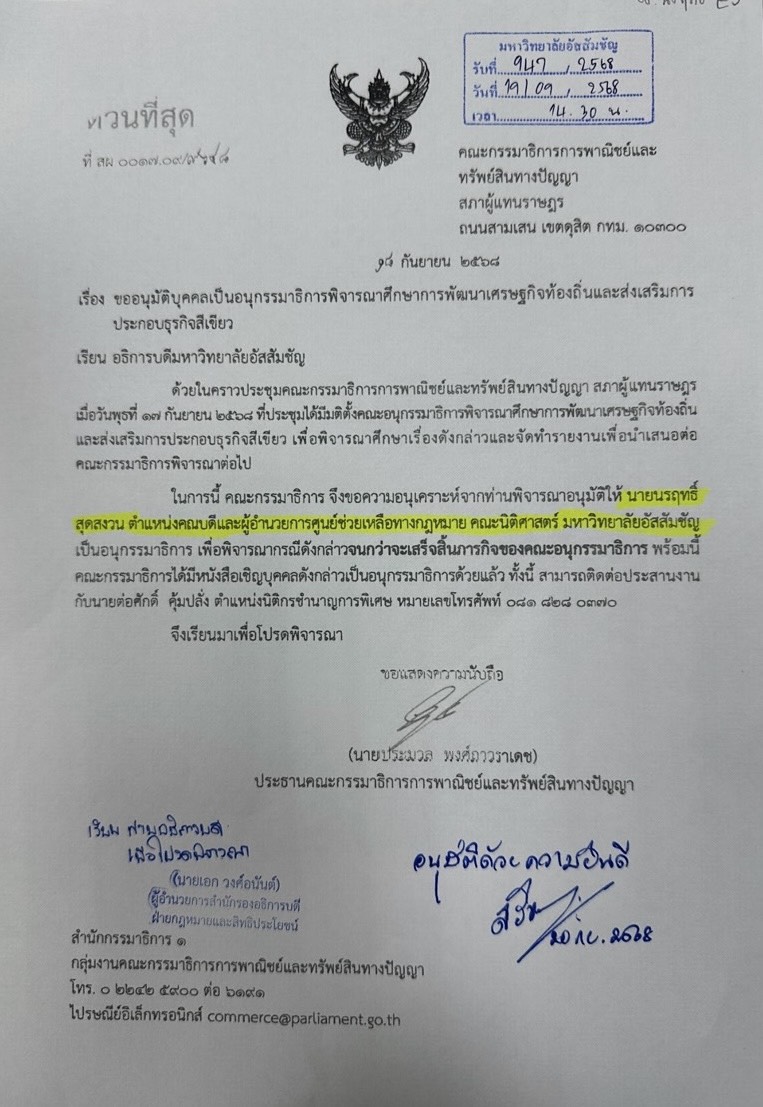
At its meeting on 17 September 2025, the Committee on Commerce and Intellectual Property of the House of Representatives resolved to establish the Subcommittee on Local Economic Development and Promotion of Green Business, to study these issues and report its findings to the Committee. On 18 September 2025, the Committee Chairman, Mr. Pramuan Pongthavaradet, formally requested the University’s approval for the Dean of the Thomas Aquinas School of Law and Director of its Legal Aid Center to serve as a subcommittee member until the subcommittee completes its mandate. The President of AU approved the appointment. Through this role, AU provides legal and academic expertise directly to national legislative policy on green business and sustainable local economies (SDG 8, SDG 12, SDG 16, SDG 17).
Subcommittee Member: Mr. Norarit Sudsanguan (นายนรฤทธิ์ สุดสงวน), Dean, Thomas Aquinas School of Law, and Director, Legal Aid Center
Reference: Letter No. สผ 0017.09/9648, Committee on Commerce and Intellectual Property, House of Representatives, 18 September 2025, “Request for approval of a subcommittee member for the study of local economic development and promotion of green business”; received by AU on 19 September 2025 (No. 947/2568) and approved by the President
Executive Board of the Distance Learning Foundation under Royal Patronage (DLTV)
Four AU personnel serve on the Executive Board of the Distance Learning Foundation under Royal Patronage, which runs the DLTV satellite distance-education system for small and remote schools across Thailand. By royal appointment, announced at the Board’s meeting No. 1/2563 on 31 January 2020, Rev. Bro. Dr. Bancha Saenghiran was appointed Advisor, and Assoc. Prof. Dr. Chanintorn Jittawiriyanukoon, Dr. Satha Pongsatha and Dr. Thanawan Pongsatha were appointed Executive Board members. All four continue to hold these positions in Academic Year 2025. The Board also includes the Permanent Secretary of the Ministry of Education, the Secretary-General of the Office of the Basic Education Commission and the Secretary-General of the Office of the Vocational Education Commission. The Board sets policy, budgets and school-selection criteria for DLTV, including support for 1,500 target schools, teacher training and distance-learning equipment. At the same meeting, Assoc. Prof. Dr. Chanintorn was assigned to a committee to analyse DLTV registration and viewing data to improve the service. Through this role, AU contributes to national policy on equitable access to quality education.
Advisor: Rev. Bro. Dr. Bancha Saenghiran. Executive Board Members: Assoc. Prof. Dr. Chanintorn Jittawiriyanukoon, Vice President for Research and Academic Services; Dr. Satha Pongsatha, Dean of School of Human Science; Dr. Thanawan Pongsatha, the Administrative Program Directors
Reference: Minutes of the Extraordinary Meeting of the Executive Board, Distance Learning Foundation under Royal Patronage, No. 1/2563, 31 January 2020 (agenda items 1.1 and 4)
Loading Viewer...
Partnership with the Ministry of Public Health on medical education
On 23 March 2026, AU and the Ministry of Public Health signed an MoU on medical education and clinical training for the newly established St. Luke School of Medicine. The partnership supports Thailand’s national policy to expand the medical workforce and improve access to quality healthcare (SDG 3, SDG 4, SDG 17).
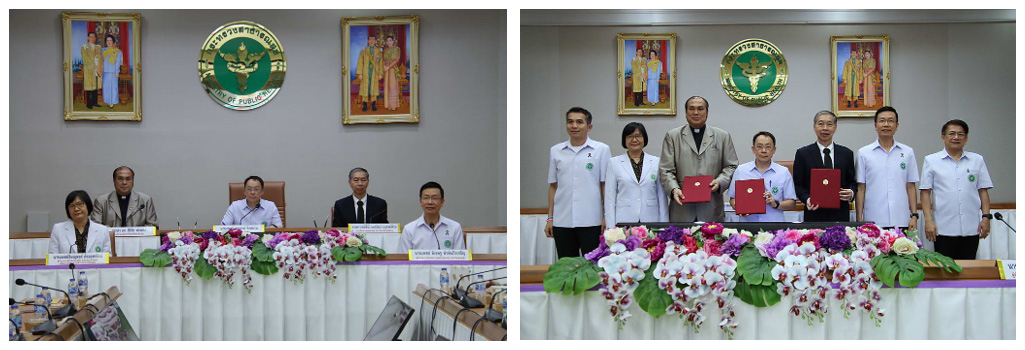
Reference: Healing Hands, Shared Vision: AU and Ministry of Public Health Sign MoU
Partnership with National Telecom PCL for Thailand’s digital workforce
On 29 April 2026, AU and National Telecom Public Company Limited (NT), a state enterprise, signed an MoU on academic cooperation, digital innovation and workforce development. The partnership supports national digital economy policy by aligning AU’s engineering and technology programmes with the needs of Thailand’s telecommunications sector (SDG 4, SDG 9, SDG 17).
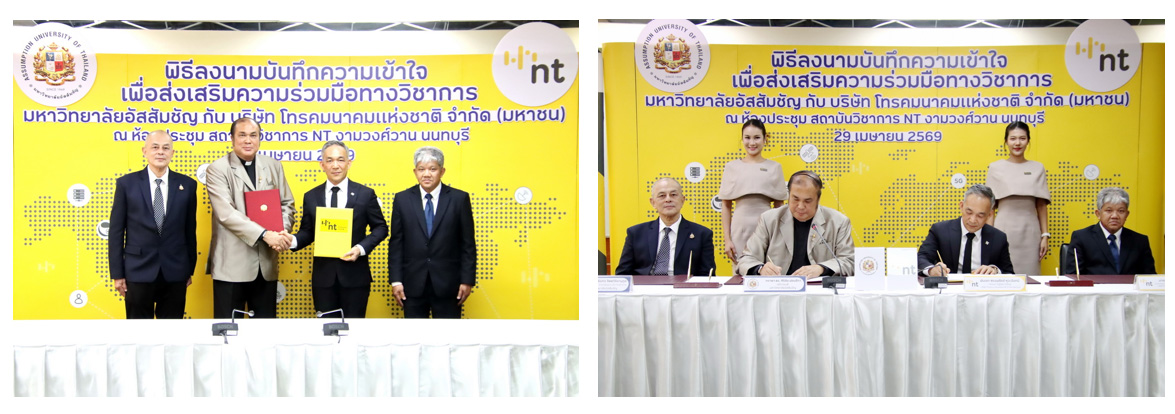
Reference: AU and National Telecom Sign MoU to Advance Thailand’s Digital Future
Teacher development with the Samut Prakan Primary Educational Service Area Office 2
AU supports the provincial education office’s policy to raise language-teaching standards. On 1 August 2025, AU hosted the second annual Chinese Language Teaching Training Project, jointly organized by the Samut Prakan Primary Educational Service Area Office 2, the Department of Business Chinese and the Institute for Research and Academic Services (IRAS), for teachers and students from 21 schools. On 30 August 2025, AU experts were invited by the same office to speak on CEFR-based English teaching to teachers and school administrators under the project “Enhancing English Skills to Improve Learning Outcomes through the CEFR Framework” (SDG 4, SDG 17).
Project Leaders: Asst. Prof. Dr. Rosukhon Swatevacharkul, English Language Teaching Program, Graduate School of Human Sciences; Dr. Nida Boonma, Institute for English Language Education, Theodore Maria School of Arts
Reference: Making English Count: AU Shares CEFR Strategies in Samut Prakan

Youth Volunteer Project 2025 with the Ministry of Higher Education, Science, Research and Innovation
Supported by the Office of the Permanent Secretary, Ministry of Higher Education, Science, Research and Innovation (MHESI), under the Ministry’s national youth volunteer policy, AU students and faculty worked with community enterprises and a social welfare organization from June to August 2025. Projects included turning Chan Krung sugarcane into value-added products, making broom products from recycled plastic bottles with the Environmental Conservation Community Enterprise Group in Pathum Thani, and a social impact project at the Camillian Home for children with disabilities. Through these projects, AU puts the Ministry’s policy on community economic development and social inclusion into practice at local level (SDG 1, SDG 8, SDG 11, SDG 12, SDG 17).
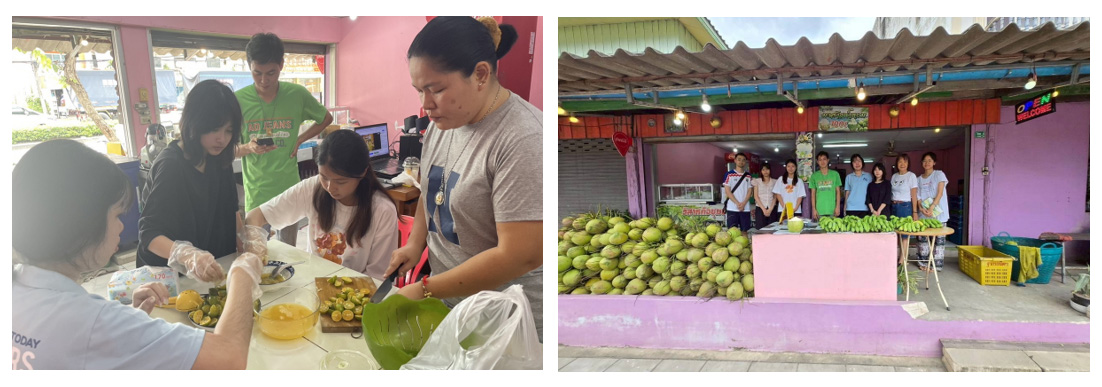
Reference: Sweet Success: MSME Students Stir Up Value-Added Sugarcane Innovation with Chan Krung
Music Boost Camp under the national soft power strategy
From 30 July to 3 August 2025, the Louis Nobiron School of Music hosted the Music Boost Camp with the Office of Knowledge Management and Development (OKMD), the Thai Audio-Visual and Music Content Association (THAACA) and the Subcommittee for Driving the Music Industry under the Prime Minister’s Office. Part of the national Talent Everywhere initiative and aligned with the One Family One Soft Power policy, the camp discovered and developed young music talent (SDG 4, SDG 8, SDG 17).
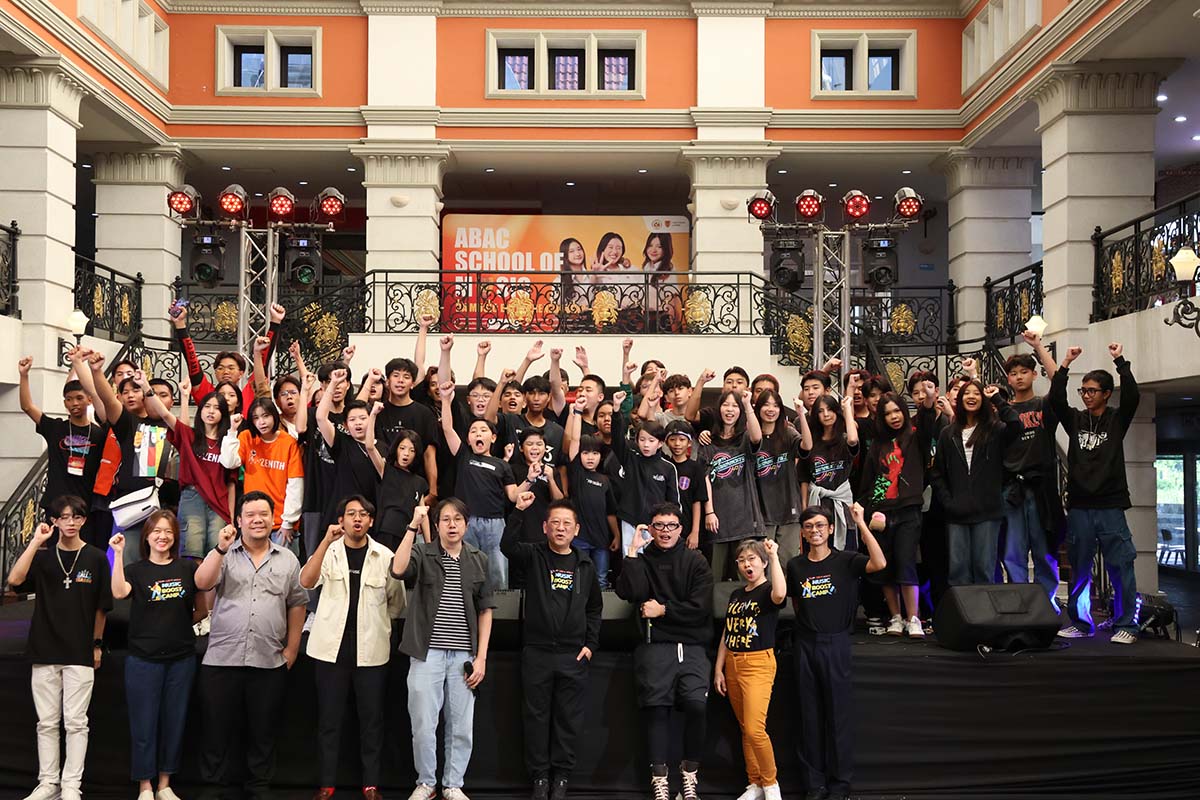
Reference: AU Hits the Right Note with Music Boost Camp
Campus food safety with Bang Sao Thong Subdistrict Administrative Organization
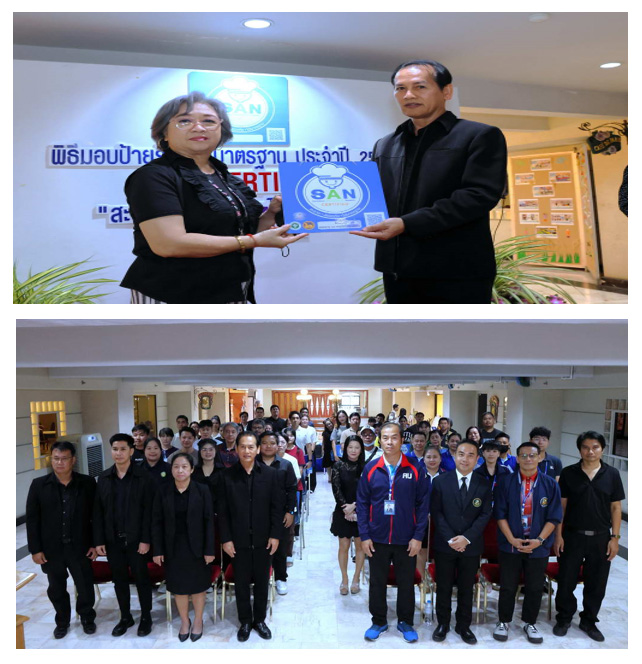
On 3 December 2025, AU and the Bang Sao Thong Subdistrict Administrative Organization held the “SAN Certified” award ceremony at Suvarnabhumi Campus. Forty-eight food vendors passed joint hygiene assessments by AU and local public health officers under the local government’s food safety standards (SDG 3, SDG 12, SDG 17).
Regional public space development with the Creative Economy Agency
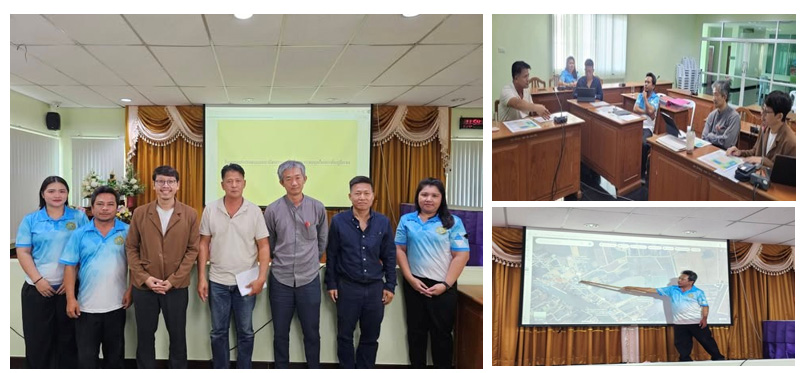
AU’s Montfort del Rosario School of Architecture and Design serves as a working committee member of the Association of Siamese Architects under Royal Patronage, Eastern Region, supporting public space development initiatives assigned by the Creative Economy Agency (Public Organization) (CEA). On 13 February 2026, the committee visited Lam Phaya Municipality, Nakhon Pathom Province, to introduce the Regional Modern Public Space Architectural Design Competition and to prepare the selection of potential sites for the national-level competition. Through this role, AU contributes architectural expertise to a national government programme on public space and sustainable urban development, working with professional organizations, government agencies and local communities (SDG 9, SDG 11, SDG 17).
17.2.2 Cross sectoral dialogue about SDGs
AU initiates and hosts dialogue among academia, industry, government and civil society on sustainable development. In Academic Year 2025, AU hosted, co-hosted or took part in at least ten conferences, seminars, symposia and workshops on sustainable food systems, air pollution, rural innovation, public space, health, emergency care and ageing, bringing together participants from government, industry, civil society and universities in Thailand and abroad.
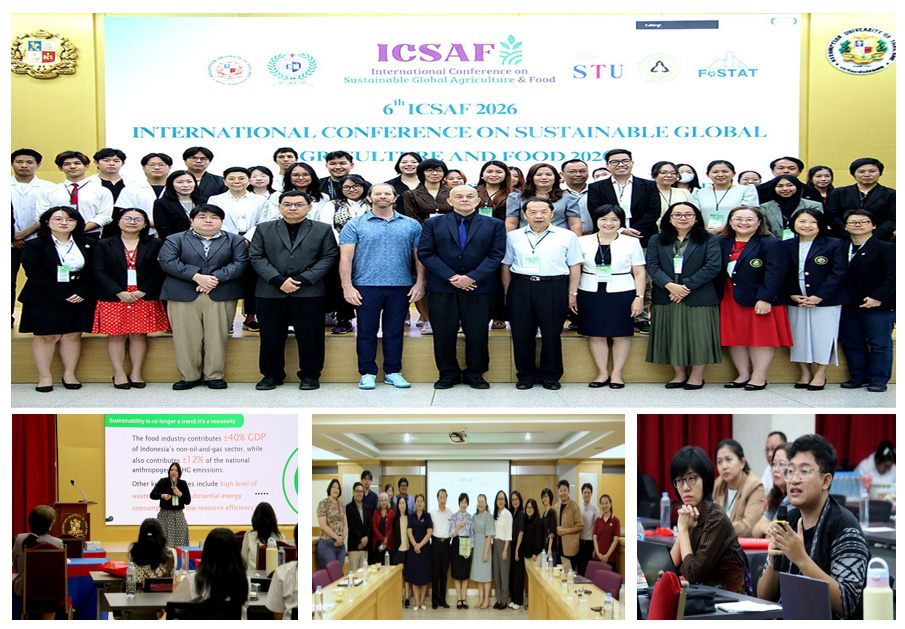
6th International Conference on Sustainable Global Agriculture and Food (ICSAF 2026)
On 5–6 March 2026, the Theophane Venard School of Food Biotechnology and Innovation hosted ICSAF 2026 under the theme “Emerging Innovations and Trends in Food Biotechnology for a Sustainable Future.” The two-day hybrid conference brought together researchers and specialists from Thailand and around the world to exchange knowledge on sustainable agriculture, food systems and human health (SDG 2, SDG 12, SDG 13, SDG 17).
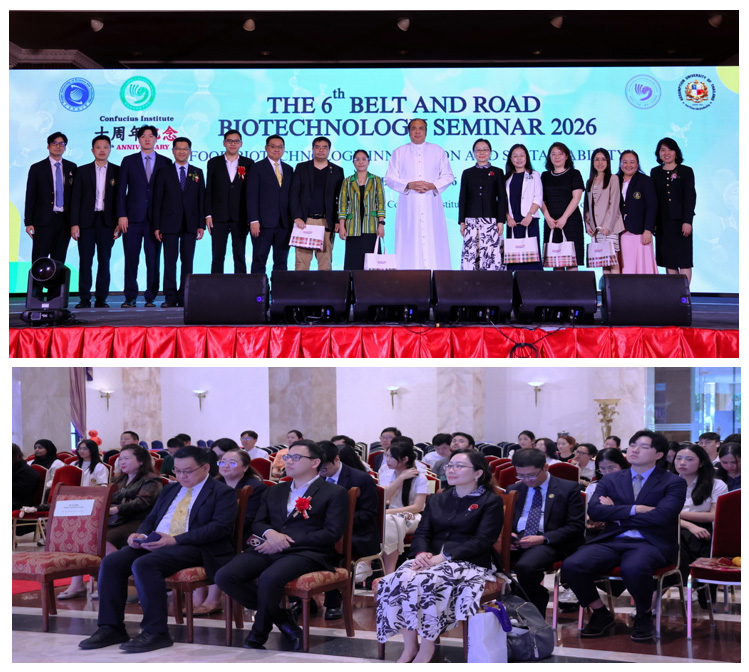
6th Belt and Road Biotechnology Seminar 2026
On 9 February 2026, AU hosted the 6th Belt and Road Biotechnology Seminar at Suvarnabhumi Campus. Researchers and practitioners discussed upcycling food and agricultural waste, algae-based wastewater treatment and novel bioresources. The seminar was opened by the President of AU, with welcome messages from representatives of partner universities and embassies (SDG 2, SDG 6, SDG 12, SDG 17).
International Academic Symposium on Cultural Technology and Social Innovation
On 19 January 2026, AU and Peking University, with support from the UNESCO Chair on Creativity and Sustainable Development in Rural Areas, hosted the International Academic Symposium on Cultural Technology and Social Innovation at Suvarnabhumi Campus. University leaders and researchers from China, Thailand, Singapore, Italy, the Republic of Korea and Indonesia discussed cultural technology, social innovation and talent development for sustainable development (SDG 4, SDG 9, SDG 11, SDG 17).
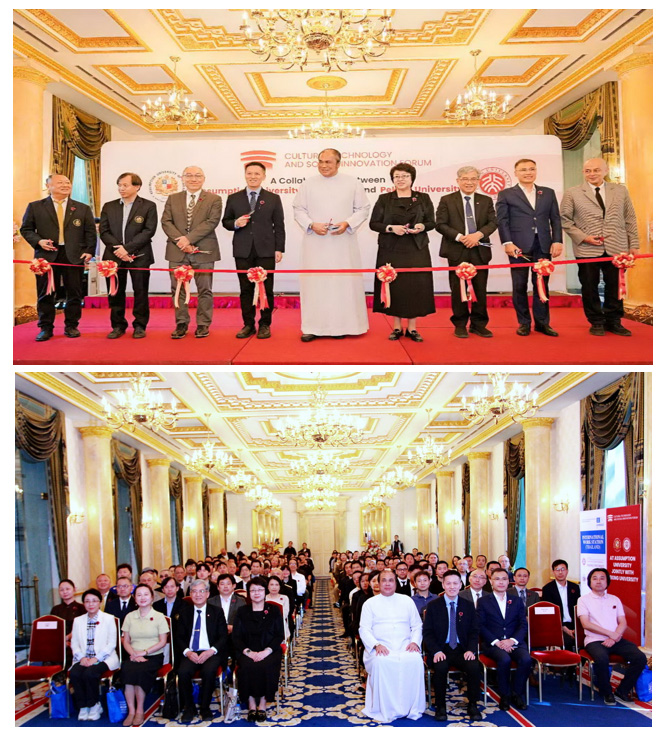
Reference: China–Thailand Academic Partnership Opens a New Chapter
CEA x ASA Workshop on Creative Public Spaces for Sustainable Communities
On 4 March 2026, the Montfort del Rosario School of Architecture and Design hosted the CEA x ASA Workshop with the Association of Siamese Architects under Royal Patronage, Burapha Regional Committee, and the Creative Economy Agency. Academics, professionals and government representatives explored site-based public space design that responds to regional identity and community needs (SDG 11, SDG 17).
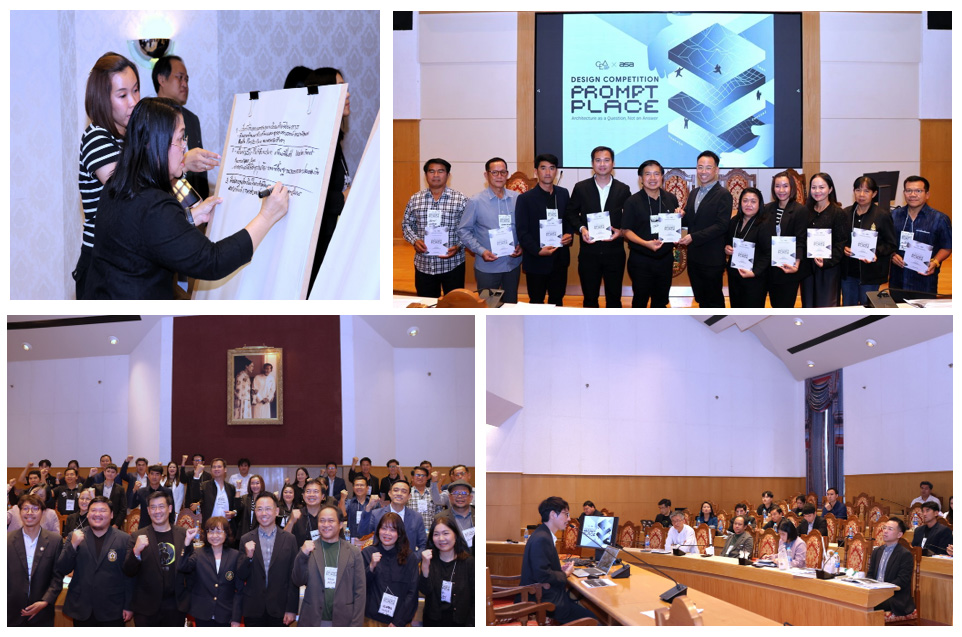
Reference: https://www.au.edu/designing-possibility-au-workshop-reimagines-creative-public-space-in-the-east/
Junior-Sci Conference: Future Food for Sustainability 2025
On 16 October 2025, AU hosted the Junior-Sci Conference on the theme “Future Food for Sustainability”, bringing together three sectors: university researchers, secondary school students and teachers from schools across Thailand, and industry experts who served on the judging panels. Students presented research on future food, food packaging innovation and sustainable, biodegradable food materials and received feedback from academic and industry experts on sustainable food challenges (SDG 2, SDG 4, SDG 12, SDG 17).
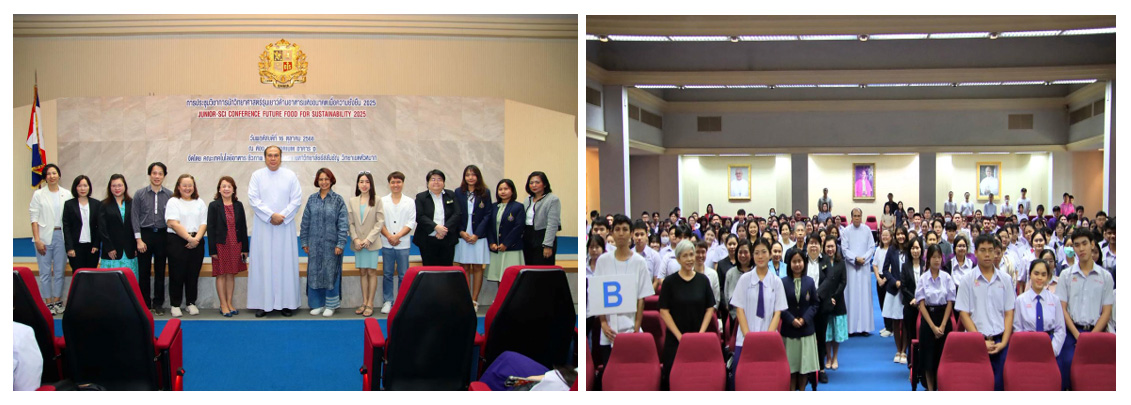
Reference: Young Innovators Take the Stage at AU’s Junior-Sci Conference
1st INACSL Thailand RIG International Annual Conference
On 23–24 May 2026, the Bernadette de Lourdes School of Nursing Science hosted the 1st INACSL Thailand RIG International Annual Conference on technology and simulation in nursing education. Nursing educators, healthcare professionals and experts from institutions including the National University of Singapore and Teikyo University, Japan, discussed patient safety, disaster preparedness and outcome-based learning (SDG 3, SDG 4, SDG 17).
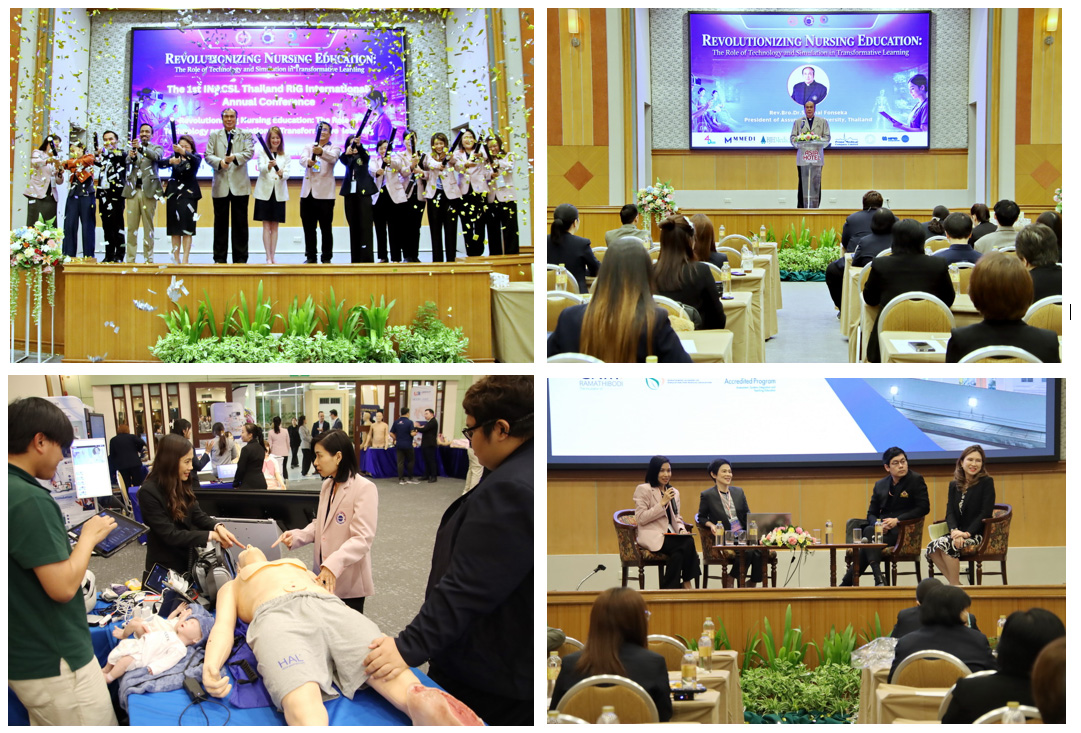
Reference: https://www.au.edu/au-school-of-nursing-science-injected-innovation-into-healthcare-education/
Partnering for Sustainable Crafts: AU Joins Nine-Country Dialogue at SACIT Symposium 2025
On 7–8 August 2025, Assumption University of Thailand (AU), through the Montfort del Rosario School of Architecture and Design, took part in the SACIT Symposium 2025 in Bang Sai District, Phra Nakhon Si Ayutthaya. The Support Arts and Crafts International Centre of Thailand (SACIT) organized the event under the theme “Crafting Sustainability across ASEAN and Beyond”. It brought together participants from nine countries, and Dr. Feng Jing of UNESCO joined in opening the symposium. Discussions covered cultural heritage, creative industries and sustainable development.
Two AU faculty members presented research on sustainable craft products. Ajarn Ornlaor Homsettee presented Thai handicraft design using teakwood residues under a circular economy framework. Ajarn Dr. Ananyaa Kannasoot presented value-added, naturally dyed souvenirs from Bang Sao Thong, Samut Prakan, developed with a sustainable fashion approach. Through this international platform, AU shared knowledge and opened opportunities for cross-border collaboration on sustainable crafts (SDG 8, SDG 11, SDG 12, SDG 17).
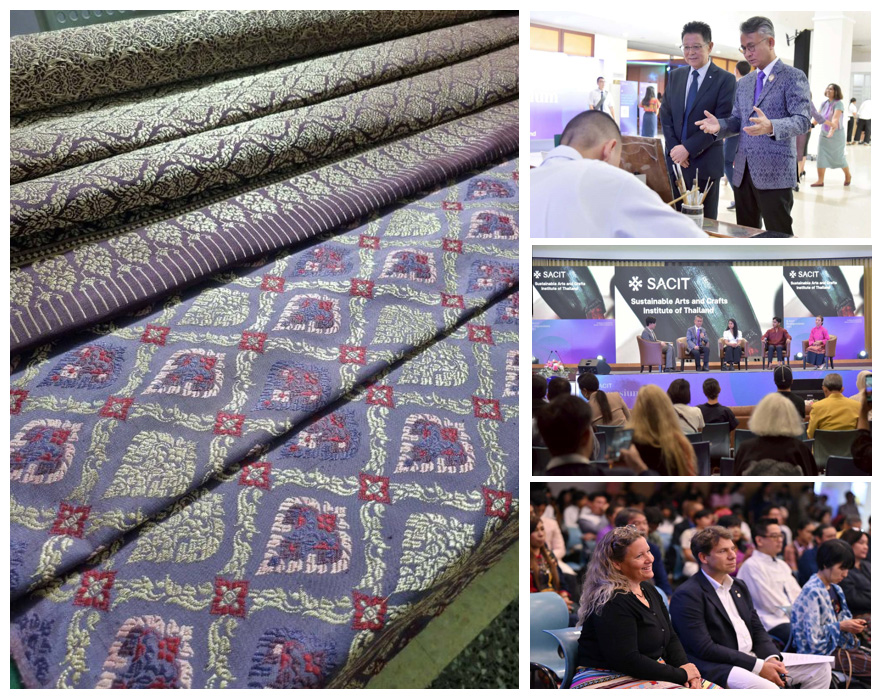
Reference: https://www.au.edu/sacit-symposium-2025-elevates-thai-handicrafts-to-the-international-stage/
Seminar on sugarcane residues and PM2.5 reduction with the Office of the Cane and Sugar Board
On 4 February 2026, the Theophane Venard School of Food Biotechnology and Innovation hosted the seminar “Innovative Transformation of Sugarcane Residues: A Strategy for PM2.5 Reduction” at Hua Mak Campus. Mr. Sitthirong Rengngieb, Deputy Secretary-General of the Office of the Cane and Sugar Board (OCSB), Ministry of Industry, presented Thailand’s efforts to reduce sugarcane burning and air pollution through cleaner harvesting practices, agricultural machinery, financial incentives and higher-value use of sugarcane residues. The seminar connected government policy with university research and students on turning agricultural waste into useful resources (SDG 3, SDG 9, SDG 12, SDG 13, SDG 17).
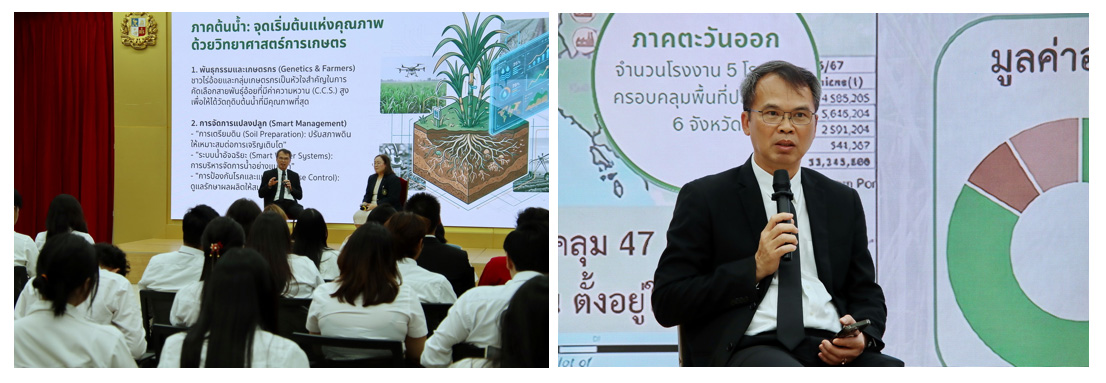
Reference: Sweet Solutions: Turning Sugarcane Waste into PM 2.5 Hope
International seminar on disaster and emergency care
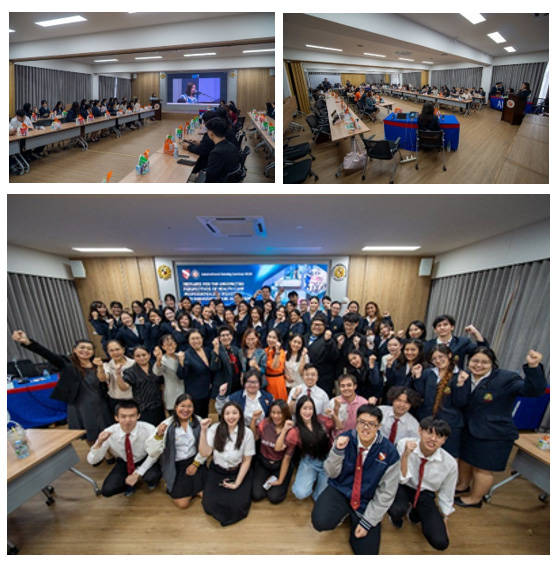
On 28 February 2026, senior nursing students of the Bernadette de Lourdes School of Nursing Science organized the hybrid international seminar “Prepared for the Unexpected: Perspectives of Health Care Professionals in Disaster and Emergency Care Management”. Speakers came from the National Institute for Emergency Medicine Services (NIEMS), a government agency; the Srisavarindhira Institute of Nursing, Thai Red Cross Society; and the Faculty of Nursing, Prince of Songkla University, with support from private-sector sponsors. A keynote and panel discussion covered emergency preparedness and response and nursing leadership under pressure (SDG 3, SDG 4, SDG 17).
Reference: https://sustainability.au.edu/report/
Music for an ageing society with King Prajadhipok’s Institute and the Medical Council of Thailand
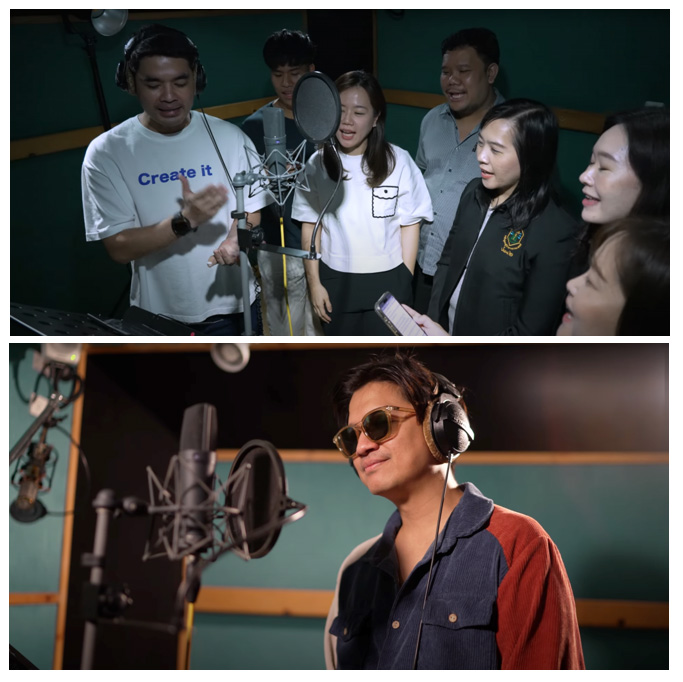
The Louis Nobiron School of Music, with King Prajadhipok’s Institute and the Medical Council of Thailand, organized the public concert “Don’t Call It Old, Just Grown Up” on 17 August 2025 at Paradise Park Shopping Center, Bangkok, under the project “The Science of Sound, the Power of Heart”. The concert was part of the research and social development initiative “Thai Culture-Based Innovative Music Therapy for Aging Society”, for which the School created four original songs representing the four regions of Thailand. The project brings together a university, a public policy institute, a professional medical body, artists and the public to promote the well-being of older adults and understanding between generations (SDG 3, SDG 4, SDG 10, SDG 11, SDG 17).
17.2.3 International collaboration data gathering for SDG
AU collaborates with international partners on research platforms that gather and share data on sustainable development, with a focus on rural sustainability, cultural innovation and biodiversity in Thailand and China.
Cultural Technology and Social Innovation Lab with Peking University
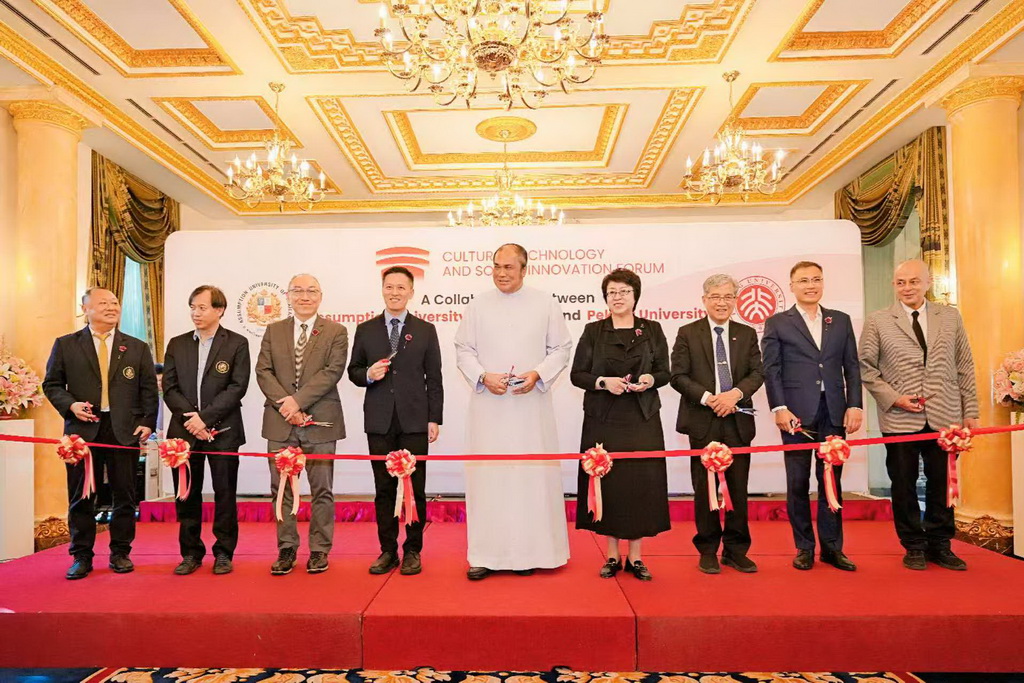
On 17 January 2026, AU and Peking University inaugurated the Cultural Technology and Social Innovation Lab, an international and interdisciplinary research platform covering art-led rural revitalization, human–machine co-creation, immersive cultural tourism and smart healthcare. Through joint research and industry-oriented projects, the Lab turns academic knowledge into practical solutions for communities (SDG 9, SDG 11, SDG 17).
Reference: China–Thailand Academic Partnership Opens a New Chapter
Global Youth Rural Creative Residency, Koh Kret
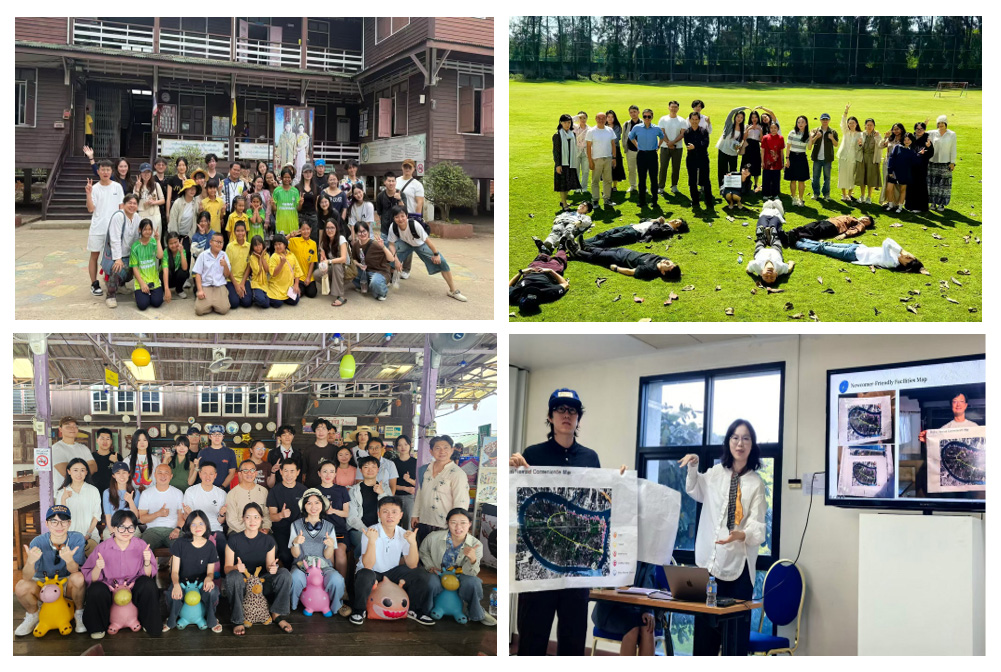
From 19 to 26 January 2026, AU and Peking University ran the Global Youth Rural Creative Residency (Thailand) on Koh Kret, Nonthaburi. Thai and Chinese faculty, students and young creators carried out field research with the local community on visitor accessibility, cultural experience and creative products. Outputs included new cycling and commercial maps, a cultural “Travel Passport”, homestay improvements and locally inspired ceramic products (SDG 8, SDG 11, SDG 12, SDG 17).
Reference: https://www.au.edu/au-and-pku-launch-global-youth-rural-creative-residency-on-koh-kret/
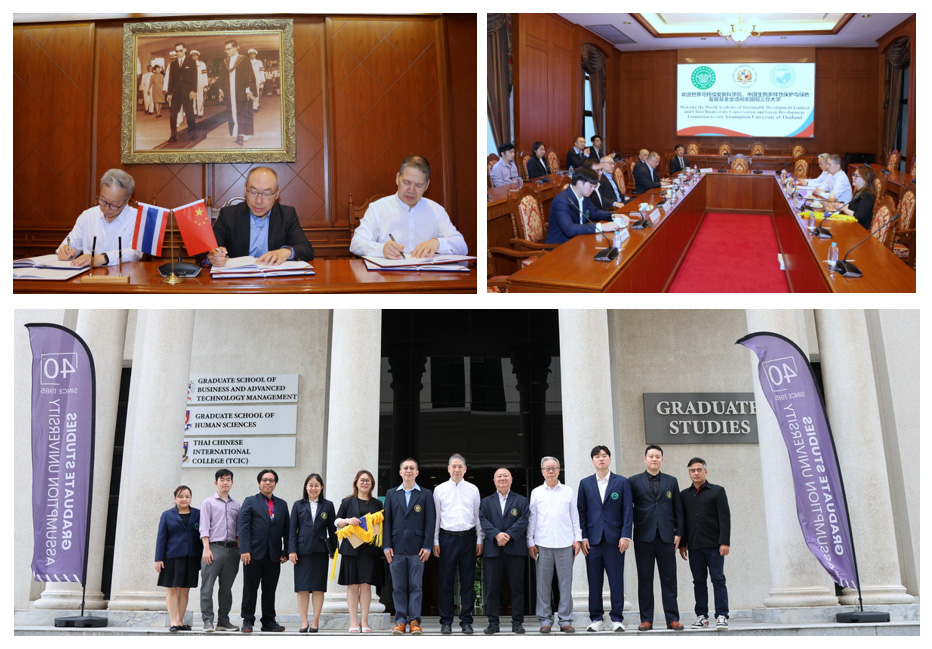
Establishment of the World Academy of Sustainable Development Science at Assumption University in Partnership with International Organizations
On 13 June 2025, Assumption University of Thailand (AU) welcomed a delegation from the World Academy of Sustainable Development and the China Biodiversity Conservation and Green Development Foundation (CBCGDF), People’s Republic of China, at its Suvarnabhumi Campus. On this occasion, the World Academy of Sustainable Development Science at AU was officially inaugurated. The institute will serve as a hub for advancing the United Nations Sustainable Development Goals (UN SDGs) in Southeast Asia through interdisciplinary research, capacity building, and international exchange.
The three institutions held in-depth discussions on sustainability education and international cooperation, which led to the signing of a formal cooperation agreement covering the following areas:
- Joint research and application of scientific findings: establishing a platform that integrates talent development, academic research, and the application of research outcomes to accelerate the global green development agenda, including green technology and ecological conservation.
- Joint master’s and doctoral programmes: with pathways for graduates to pursue postdoctoral research at Peking University, Tsinghua University, and the Chinese Academy of Social Sciences.
- An SDG-based Model United Nations student association: to cultivate global citizenship and leadership among young people.
Under the cooperation agreement signed on 13 June 2025, AU, the World Academy of Sustainable Development and the China Biodiversity Conservation and Green Development Foundation (CBCGDF) agreed to establish a joint platform for research on green development and ecological conservation. The World Academy of Sustainable Development Science at AU is the permanent institutional mechanism for this collaboration. Through it, the partners conduct joint research, share scientific findings, and apply research outcomes to green technology and biodiversity conservation. CBCGDF contributes its international network of conservation and green-economy practitioners, while AU and the World Academy of Sustainable Development contribute research capacity and academic expertise. The institute therefore gives AU a standing framework for international collaboration on gathering and sharing research evidence on climate action, biodiversity and green development.
Reference: AU’s Bold New Step in Green Diplomacy and Education
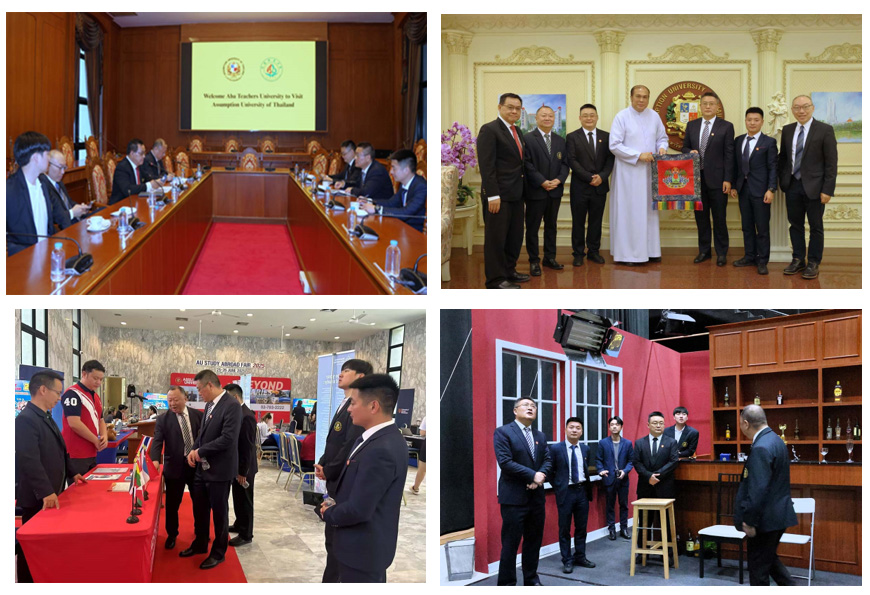
Sino-Thai Research Center with Aba Teachers University
On 25 June 2025, Assumption University of Thailand (AU) and Aba Teachers University (China) signed six cooperation agreements and inaugurated the Thai base of the Sino-Thai Research Center for Basic Education of Nationalities. The Center serves as an international platform for comparative research on basic education in ethnic regions, teacher professional development, and localized curriculum innovation, with the aim of promoting educational equity across the region. This partnership enables both institutions to jointly gather, analyze, and share education data that supports SDG 4 (Quality Education) and SDG 17 (Partnerships for the Goals).
Reference: AU and Aba Teachers University Expand Belt and Road Cooperation with Sino-Thai Research Center
17.2.4 Collaboration for SDG best practice
AU collaborates internationally to research, compare and share best practice on the SDGs. Its main channel is the UNESCO International Workstation on Rural Creativity and Sustainable Development (Thailand), hosted by AU in partnership with Peking University. During the 2025 academic year, AU also developed new international partnerships focused on sustainable urban development, clean transport and sustainability education.
UNESCO International Workstation on Rural Creativity and Sustainable Development
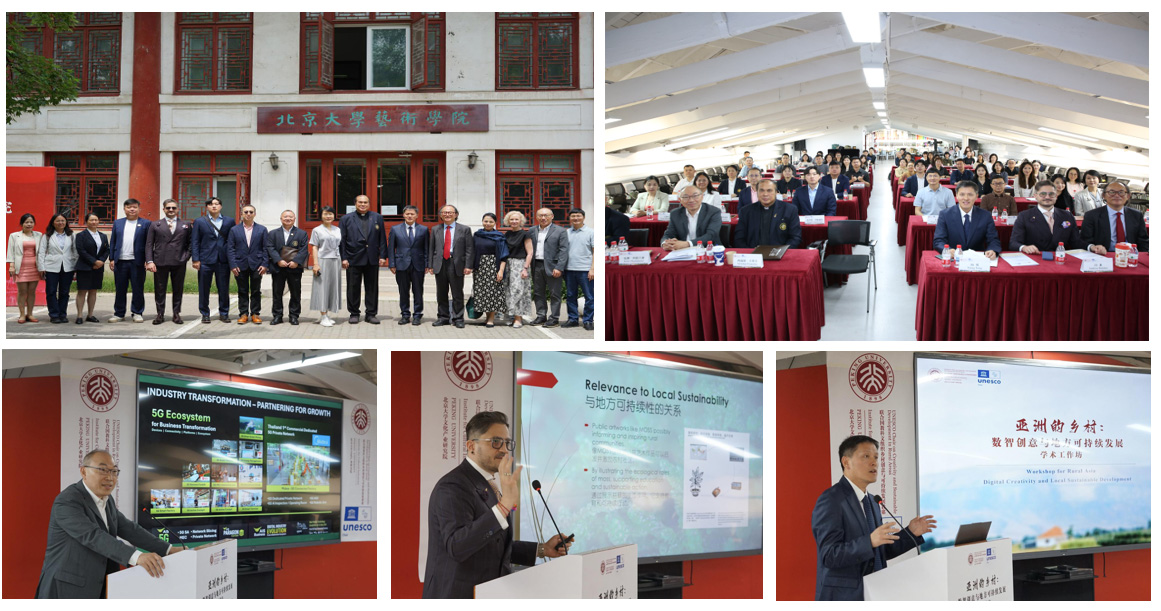
Background: The Workstation was established in May 2025 as an extension of the UNESCO Chair on Rural Creativity and Sustainable Development. It was launched at the international workshop “Rural Asia: Digital Creativity and Local Sustainable Development” at Peking University, where more than 100 scholars and experts from Asia and Europe discussed rural revitalization models and strategies for safeguarding intangible cultural heritage. AU presented Thailand’s rural practices in digital technology and smart innovation, and participants adopted the Beijing Initiative for Sustainable Rural Development in Asia. The Workstation is supported by 15 partner universities, companies and foundations from China, South Korea and France. It focuses on joint research on artificial intelligence and cultural innovation, international scholar and student exchange, and pilot “Digital Intelligence + Culture” projects in rural Thailand.
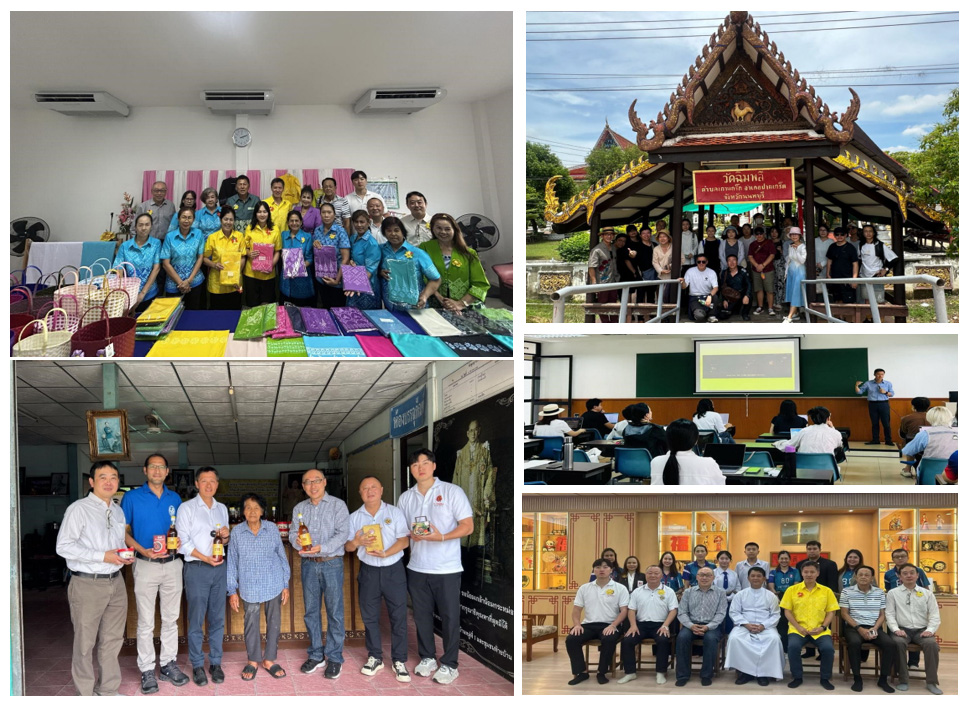
Activities in the 2025 academic year: From 19 to 22 August 2025, the Workstation carried out its first major initiative in Thailand, led jointly by the Institute of Cultural Industries at Peking University and AU:
Academic seminars (19–20 August): An open lecture on innovative technologies in cultural management for AU doctoral students in Arts, Music, Sports and Entertainment Management, covering digital creativity, cultural heritage innovation and the role of intelligent technology in traditional culture. The sessions laid the groundwork for joint training of cultural technology talent.
Field survey on Koh Kret (21 August): Researchers from Peking University and AU led doctoral students to study the Mon art community, visiting historic temples, a 180-year-old rice mill, a cultural learning center and a pottery center, and engaging with local artisans on how Mon pottery sustains cultural identity.
Regional exchanges in Sriracha (22 August): The delegation discussed cultural resource management with the Bang Phra Administration Organization, studied traditional fish sauce production, and explored future collaboration with Assumption College Sriracha.
These activities brought Chinese expertise in rural creativity into dialogue with Thai community practice, building shared knowledge on using cultural heritage and digital technology for sustainable rural development (SDG 4, SDG 8, SDG 11, SDG 17).
Reference: https://www.au.edu/unesco-launches-thailand-workstation-at-au-to-lead-rural-innovation-in-asia/
World Academy of Sustainable Development Science at AU
On 13 June 2025, AU inaugurated the World Academy of Sustainable Development Science at AU with the World Academy of Sustainable Development and CBCGDF. The institute serves as a hub for sharing good practice on the UN SDGs in Southeast Asia through capacity building and international exchange. Under the cooperation agreement, the partners will develop joint master’s and doctoral programmes with postdoctoral pathways at Peking University, Tsinghua University and the Chinese Academy of Social Sciences, and will establish an SDG-based Model United Nations student association to develop global citizenship and leadership among young people (SDG 4, SDG 13, SDG 15, SDG 17).
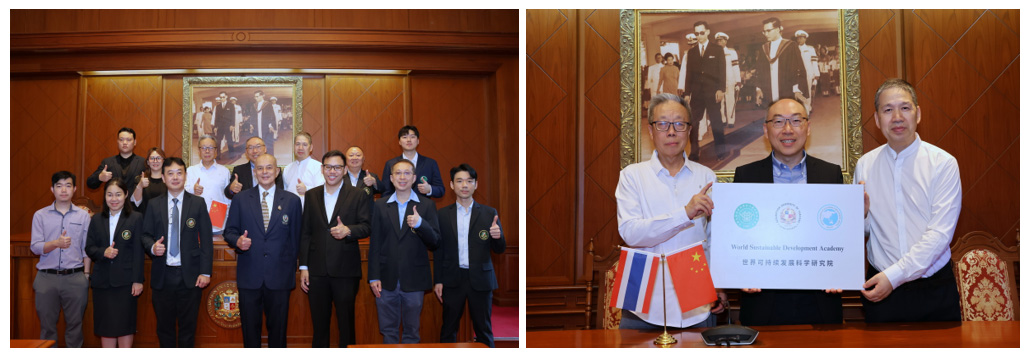
Reference: https://www.au.edu/aus-bold-new-step-in-green-diplomacy-and-education/
Integrated Real Estate Project with the University of Malaya
Following an MoU signed on 13 August 2025, the Martin de Tours School of Management and Economics and the Faculty of Built Environment, University of Malaya, ran the Integrated Real Estate Project from 13 to 18 August 2025. Students and faculty from both universities took part in workshops, expert lectures and field visits to real estate and urban development sites in Bangkok, including meetings with government agencies, to compare and share practice in sustainable urban development
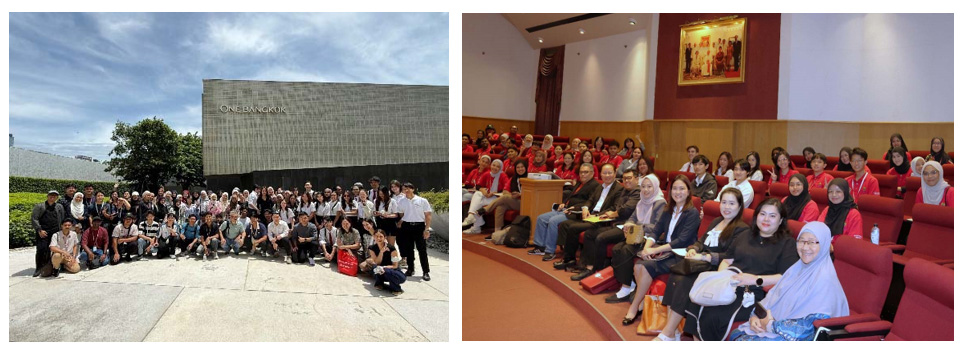
Reference: https://www.au.edu/au-and-university-of-malaya-launch-integrated-real-estate-project-in-bangkok/
International NEV Science and Education Alliance
On 17 October 2025, a government delegation from Hongkou District, Shanghai, visited the Industry–Education Integration Base of the International New Energy Vehicle (NEV) Science and Education Alliance, a joint initiative of AU and SAIC Motor Thailand (MG). The visit shared practice in training skilled talent for the clean-transport sector across ASEAN.
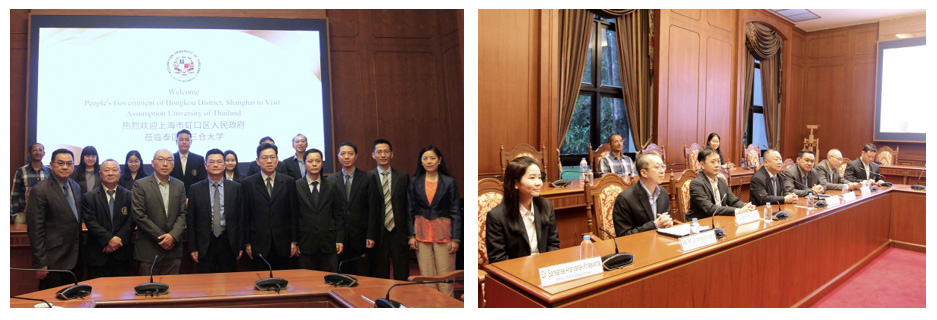
Reference: https://www.au.edu/powering-the-future-shanghai-and-au-plug-into-nev-collaboration/
Food science collaboration with Tianjin University of Science and Technology
On 17 November 2025, an AU delegation visited Tianjin University of Science and Technology, China, to exchange practice in biotechnology, food science and fermentation, develop joint degree programs and research, and expand the Confucius Institute at AU (SDG 4, SDG 9, SDG 17)
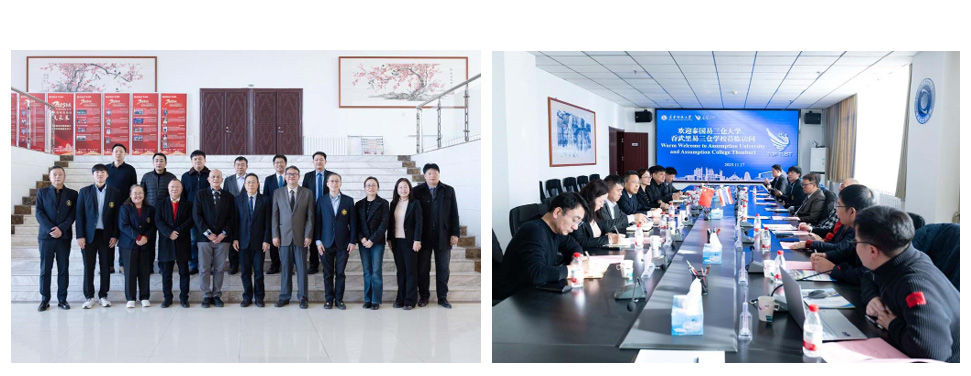
Reference: https://www.au.edu/au-and-tust-expand-collaboration-in-education-research-and-innovation/
Global Alliance for the Cultivation of High-Skilled NEV Talent
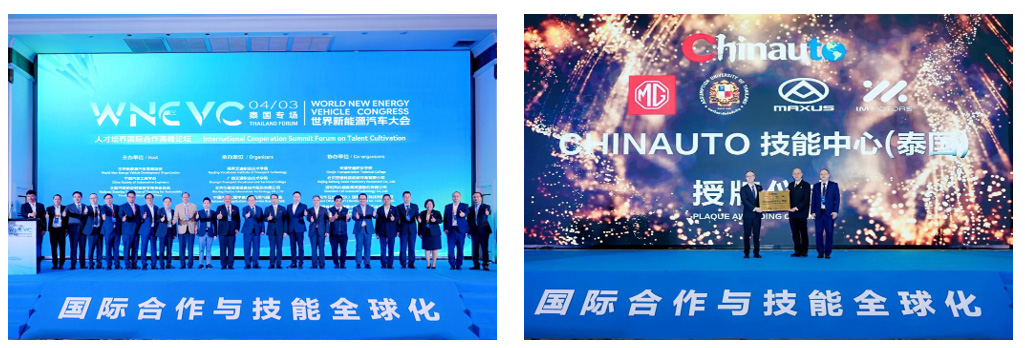
From 2 to 4 April 2026, Bangkok hosted the 2026 World New Energy Vehicle Conference (Thailand Session) and International Cooperation Summit on Talent Development, under the themes “Transportation Transformation and Sustainable Development” and “International Cooperation and Skills Globalization”. At the conference, AU became one of the first members and a core institution of the newly launched Global Alliance for the Cultivation of High-Skilled NEV Talent, whose founding institutions come from Thailand, Malaysia, Indonesia and Vietnam. AU also received the world’s first Chinauto Skills Center designation (No. 2026001). Through the Chinauto Program, partners share practice via joint curriculum development, faculty exchange and co-training, and shared practical training resources for low-carbon transport in Thailand and ASEAN (SDG 4, SDG 8, SDG 9, SDG 13, SDG 17).
17.2.5 Collaboration with NGOs for SDGs
AU collaborates with NGOs, foundations and professional associations through student volunteering, joint programmes and educational activities. In Academic Year 2025, AU worked with at least eight such organizations, several in long-running partnerships.
Thai Art and Culture Promotion Program with the Ruamchit-Normklao Foundation
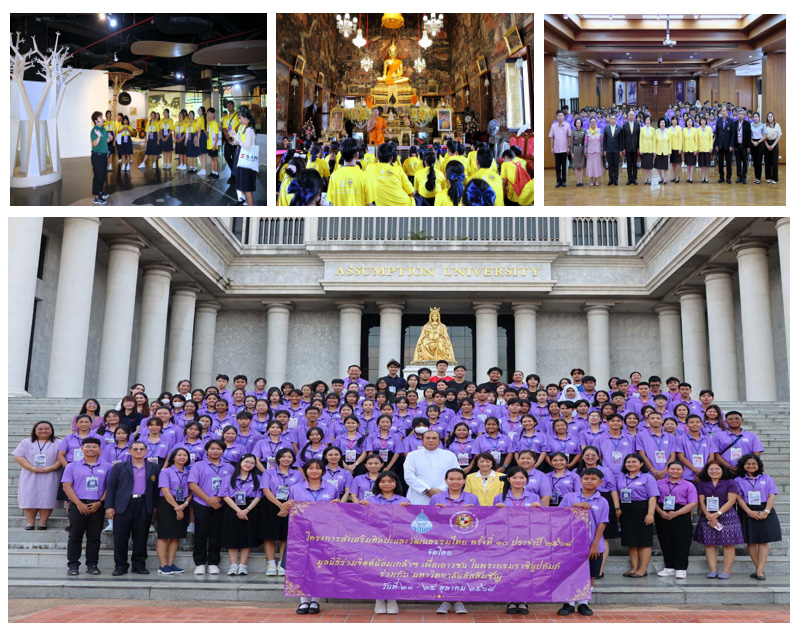
From 21 to 25 October 2025, AU and the Ruamchit-Normklao Foundation for Youth under Royal Patronage hosted the 10th Thai Art and Culture Promotion Program for scholarship recipients from all 77 provinces. Participants visited the Grand Palace, Wat Arun, Museum Siam and other heritage sites, with AU students and staff supporting the programme (SDG 4, SDG 10, SDG 11, SDG 17).
Reference: https://www.au.edu/au-partners-with-ruamchit-normklao-foundation-to-champion-thai-cultural-heritage/
Social impact project at the Camillian Home
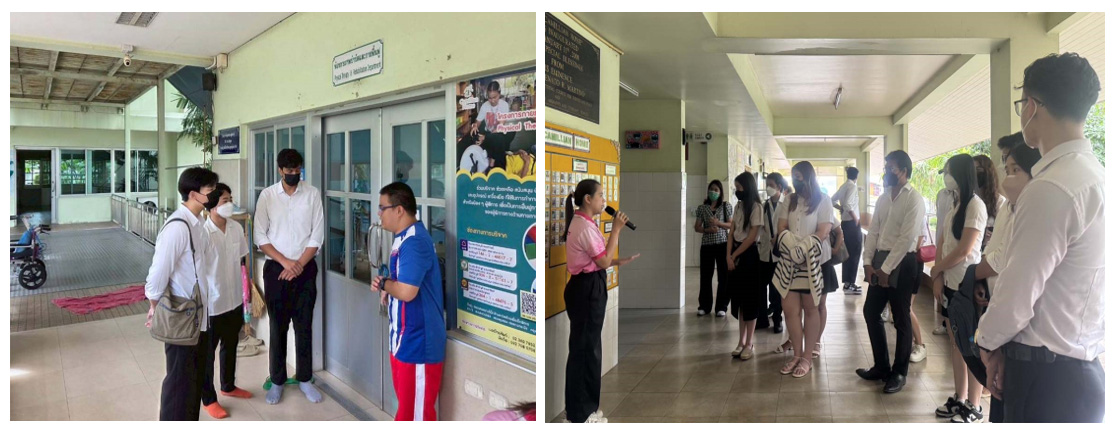
On 20 June 2025, AU students and faculty began a social impact project at the Camillian Home for Children Living with Disabilities, operated by the St. Camillus Foundation of Thailand, as part of the Youth Volunteer Project 2025, focusing on inclusion and empowerment (SDG 1, SDG 10, SDG 17).
Reference: https://www.au.edu/empathy-in-action-au-students-begin-social-impact-project-at-camillian-home/
Blood donation drive with the Thai Red Cross Society
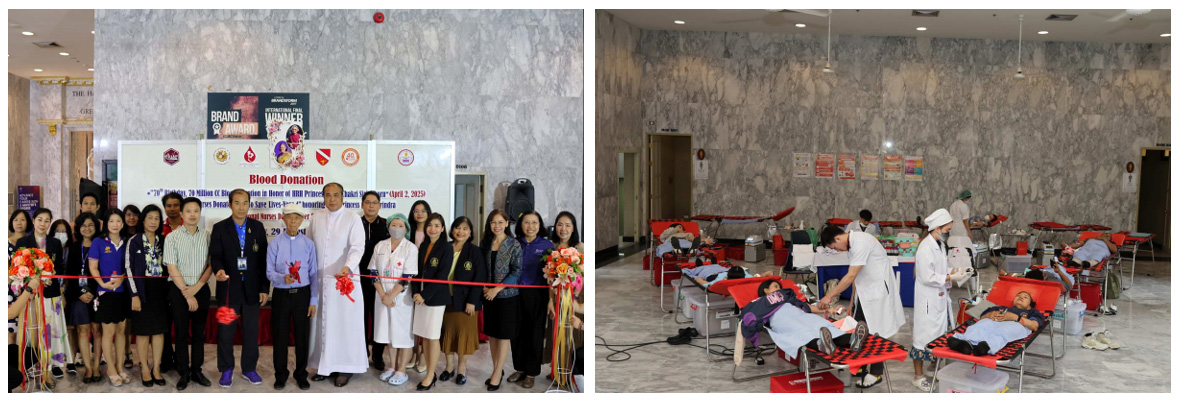
On 29 August 2025, the Bernadette de Lourdes School of Nursing Science and the Thai Red Cross Society organized a blood donation drive at Suvarnabhumi Campus, giving nursing students experience in organizing community health activities (SDG 3, SDG 17). The drive was co-organized by the Student Council of Nursing Science, a student-led society.
Reference: https://www.au.edu/type-au-positive-nursing-science-and-red-cross-unite-to-save-lives/
Charity teaching project at the Baan Nok Kamin Foundation
On 25 February 2026, the English Language Teaching (ELT) Program of the Graduate School of Human Sciences ran its second charity project, “Sharing Knowledge, Spreading Love”, at the Baan Nok Kamin Foundation. MA ELT students and faculty volunteered to teach the foundation’s children English through interactive conversation activities and provided a free lunch, funded by money the students raised at ELT booth activities at the IELE Language Café on 21 January 2026 (SDG 4, SDG 10, SDG 17).
Project Leaders: Dr. Marilyn Deocampo, Program Director, and Asst. Prof. Dr. Rosukhon Swatevacharkul, English Language Teaching Program, Graduate School of Human Sciences
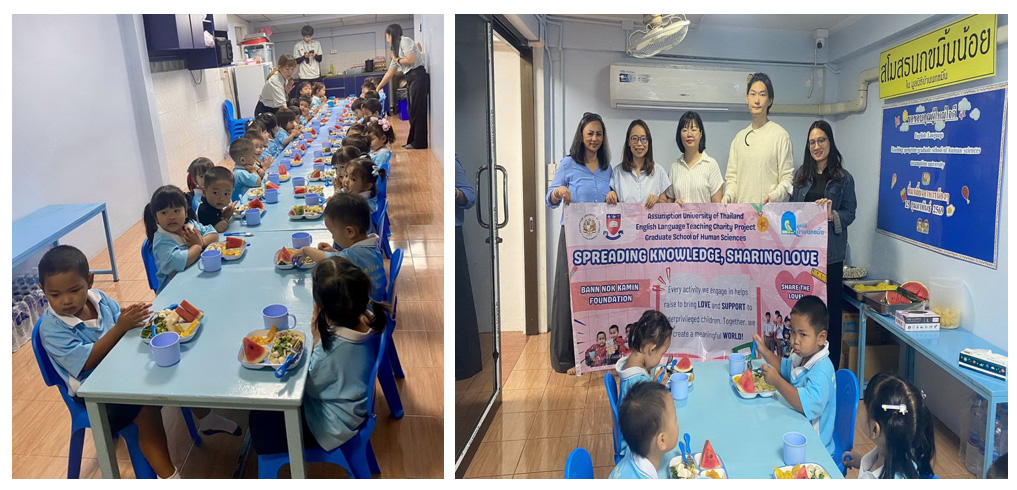
Reference: https://www.au.edu/english-language-teaching-charity-project-sharing-knowledge-spreading-love/
Student-led volunteering with international and local non-profit organizations
AU student-led societies volunteer with youth NGOs and charitable foundations, linking students to community needs.
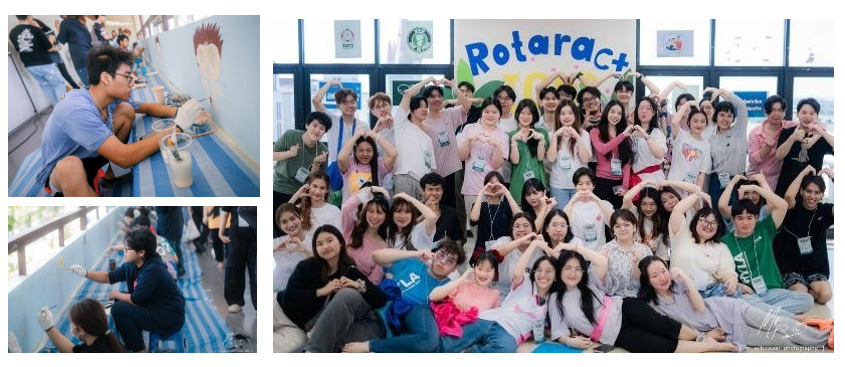
- Rotaract Club of Assumption University (Rotary International youth programme): Induction Camp on 14–16 November 2025 at Suvarnabhumi Campus. New members painted murals for pupils at Chumchonwatbanrakad School, Samut Prakan, to improve the learning environment.
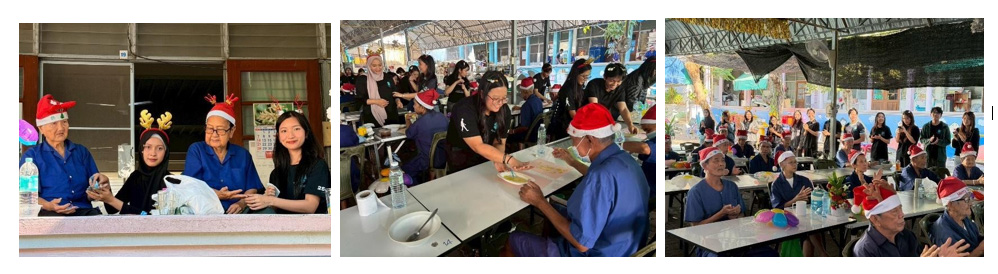
- AIESEC in Assumption University (international youth-run non-profit): “Christmas: I Generation of Warmth” on 28 December 2025 at the Watthana Niwat Foundation, Samut Prakan. Members spent the day with older residents through painting, singing and dancing, shared a meal with them and donated lunch and essential supplies.
Reference: Student-Led Societies Promoting Sustainability, Academic Year 2025 (internal document), items 1.4 and 2.2
Professional and charitable partnerships
Bird Conservation Society of Thailand (BCST) – development of educational resources
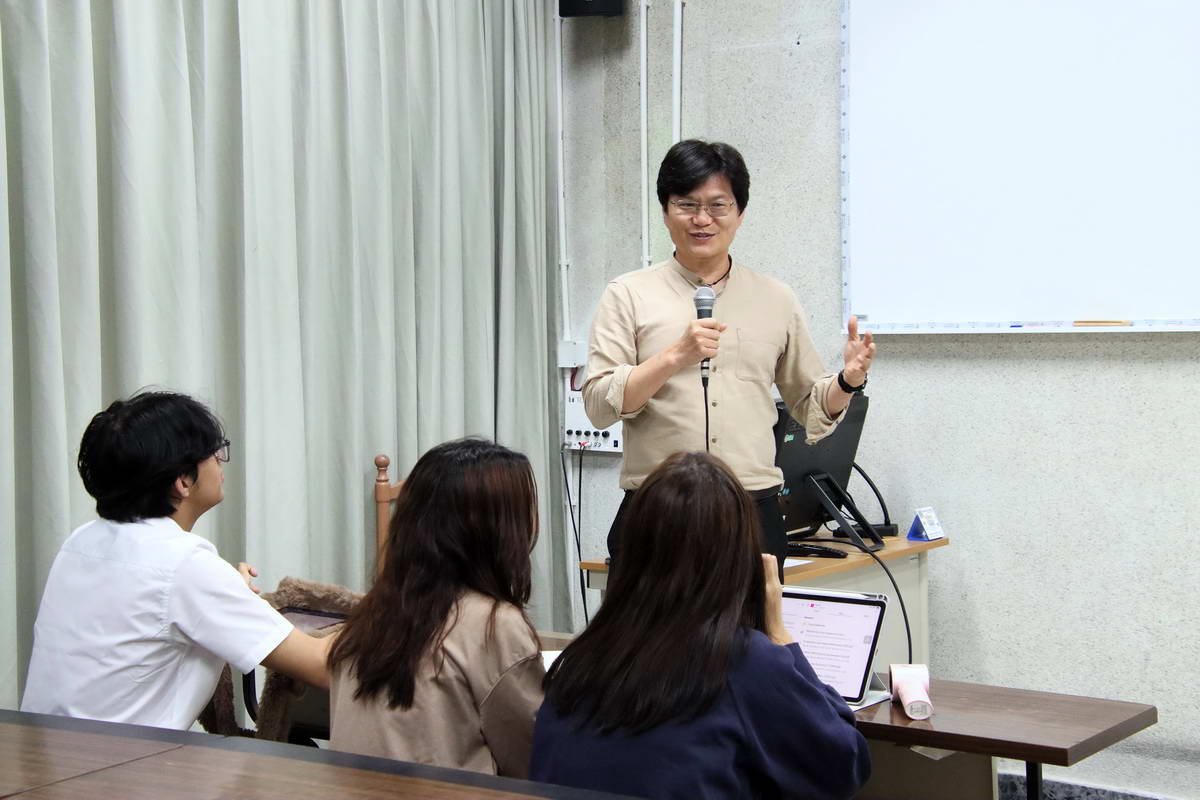
BCST President Dr. Petch Manopawitr delivered a guest lecture on biodiversity and environmental conservation for Environmental Conservation course on 4 July 2025, hosted by the Theophane Venard School of Food Biotechnology and Innovation
Association of Siamese Architects under Royal Patronage (ASA) – research programmes and educational resources
An MoU signed on 17 February 2026 covers joint research, internships, expert exchange and community-focused academic services
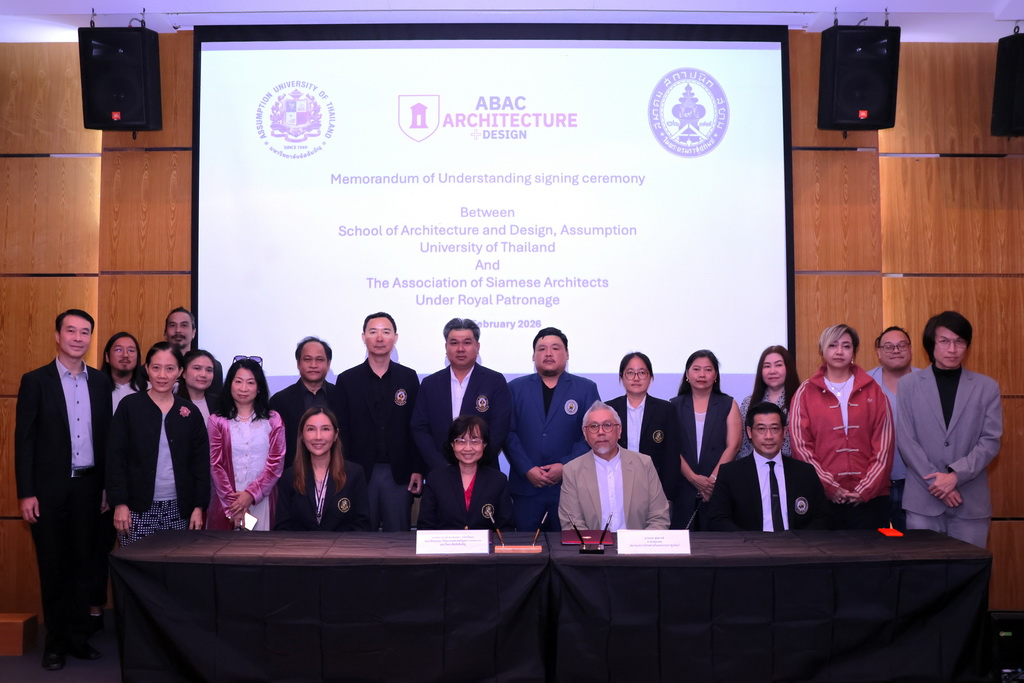
Reference: https://www.au.edu/building-better-futures-au-signs-mou-with-siamese-architects-association/
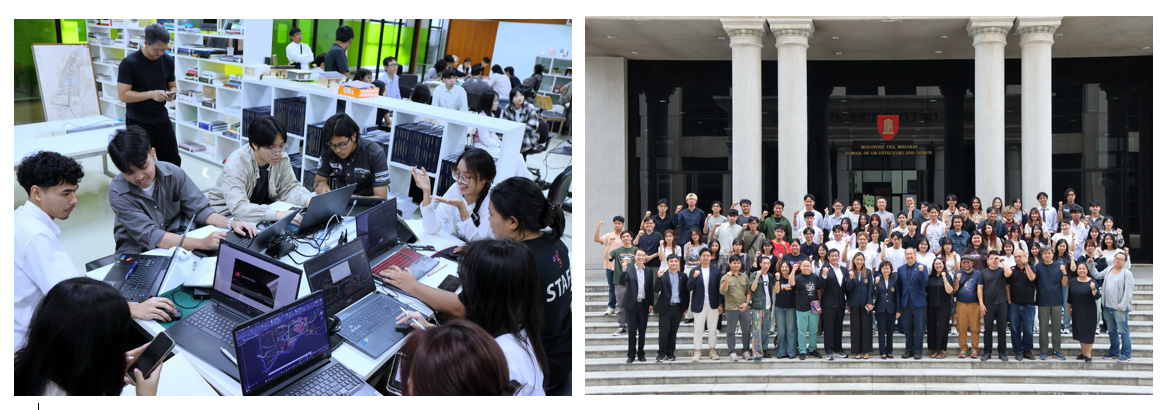
AU and ASA co-hosted the ASA Architectural Design Student Workshop 2026 (31 March – 3 April 2026). Students from 37 institutions designed small-scale public spaces that respond to community needs
Securities Investors Association of Thailand (SIAT) – educational resources
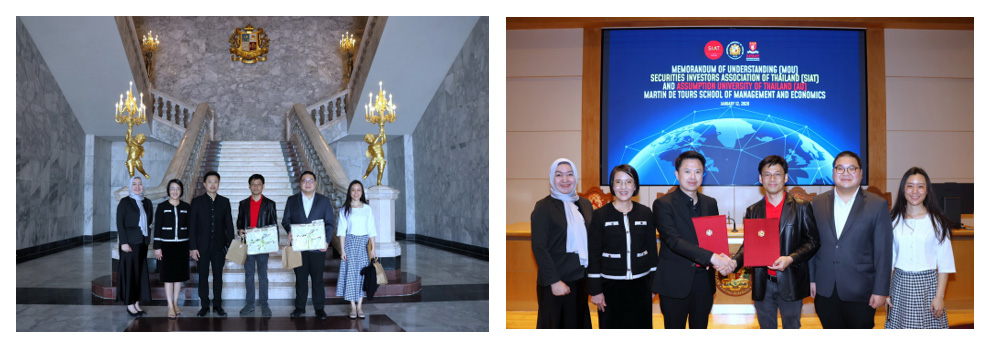
An MoU signed on 12 January 2026 supports finance and investment education, including professional ethics and responsible investment
17.3 Publication of SDG reports
AU publishes annual progress reports on its contribution to the SDGs. The SDG Report 2025 is publicly available on the AU sustainability website, which also maintains a dedicated page for each of the 17 goals. The Academic Year 2025 Sustainability Report documents 146 projects from 14 schools and units, each mapped to related SDGs, and covers all 17 goals; SDG 4 (139 projects), SDG 17 (110), SDG 9 (75) and SDG 8 (62) are the most frequently addressed.
Reference: https://sustainability.au.edu/report/
Reference: https://sustainability.au.edu/goal17/
Reference: https://sustainability.au.edu/
Loading Viewer...
17.4 Education for the SDGs
17.4.1 Education for SDGs commitment to meaningful education
AU has a formal, university-wide commitment to education for sustainable development. University Announcement No. 5/2568, Policy on Driving the Sustainable Development Goals, issued on 1 April 2025 by the President, Rev. Bro. Dr. Sirichai Fonseka, applies to all staff and students. It is aligned with the AU Strategic Plan for Academic Years 2023–2027 (revised 2025–2027) and the UN SDGs. Under its section on Education for Sustainable Development, AU commits to:
- Integrate sustainability into curricula so that students gain the relevant knowledge and skills;
- Promote lifelong learning and education for people of all ages on sustainability; and
- Develop training courses and activities that support sustainability.
The commitment is carried into teaching across faculties. On 25 March 2026, around 30 deans, directors and faculty members established the AU Social Teaching framework, which integrates seven principles of Catholic Social Teaching, including human dignity, solidarity, the common good and the option for the poor and vulnerable, into ethics and moral education across academic programmes. In Academic Year 2025, 139 of 146 reported projects (95%) were linked to SDG 4, Quality Education. AU’s sustainability work is overseen by its Sustainability Committee.
Reference: Sustainable Development Policy (University Announcement No. 5/2568)
Reference: AU Launches AU Social Teaching Initiative to Strengthen Ethical Awareness Across Academic Programs
Reference: Sustainability Committee, Assumption University
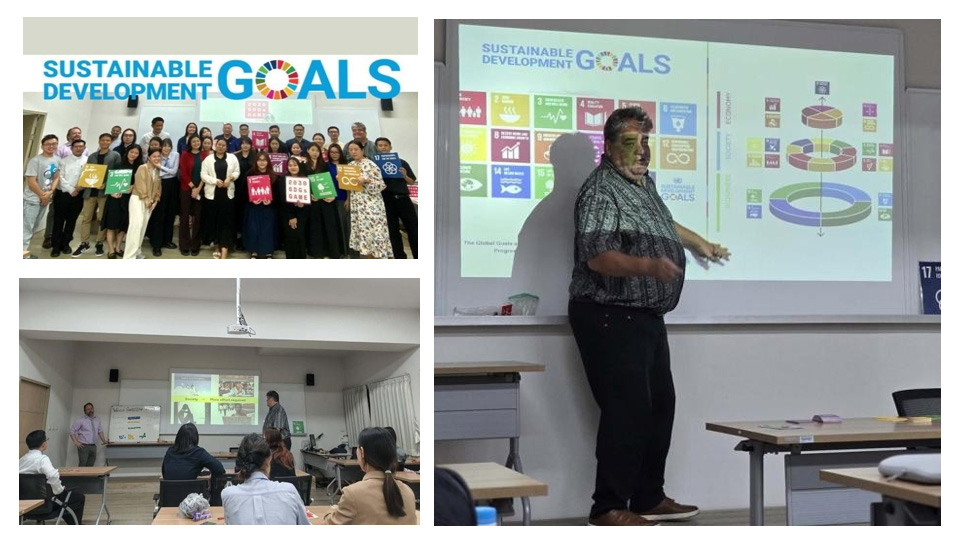
Students also learn about the SDGs through experiential activities. For example, on 9 December 2025 the AU Library ran the 2030 SDGs Game, in which graduate students explored sustainable development through strategy, negotiation and reflection (participation and evaluation results are reported under 17.4.4).
Course-level evidence, Academic Year 2025
The policy commitment to integrate sustainability into curricula (item 2.1) is reflected in the courses AU teaches. Of the 1,906 courses in the Academic Year 2025 course list (TQF3), 249 address one or more SDGs. SDG education reaches all students through three routes.
1) Education integrated across full curriculum. 224 courses in all 11 faculties integrate SDG content into their discipline, from sustainable business and renewable energy to community nursing, food safety, urban planning, human rights law and teacher education. The table below shows coverage by faculty; the full list is in Appendix 17.4.1.
Loading Viewer...
2) Mandatory education for all. The Professional Ethics Seminar series is a graduation requirement, so every student completes SDG-related education on ethics, integrity and responsible citizenship.
|
Course ID |
Course Name | Faculty | Level |
SDGs |
|
BG1403 |
Business Ethics Seminars |
Student Affairs Office |
Undergraduate |
8, 16 |
|
BG14031 |
Professional Ethics Seminar I |
Student Affairs Office |
Undergraduate |
4, 16 |
|
BG14032 |
Professional Ethics Seminar II |
Student Affairs Office |
Undergraduate |
4, 16 |
|
BG14033 |
Professional Ethics Seminar III |
Student Affairs Office |
Undergraduate |
4, 16 |
|
BG14034 |
Professional Ethics Seminar IV |
Student Affairs Office |
Undergraduate |
4, 16 |
|
BG14035 |
Professional Ethics Seminar V |
Student Affairs Office |
Undergraduate |
4, 16 |
|
BG14036 |
Professional Ethics Seminar VI |
Student Affairs Office |
Undergraduate |
4, 16 |
|
BG14037 |
Professional Ethics Seminar VII |
Student Affairs Office |
Undergraduate |
4, 16 |
|
BG14038 |
Professional Ethics Seminar VIII |
Student Affairs Office |
Undergraduate |
4, 16 |
3) Optional education for all. 16 General Education electives on SDG topics are open to students in every programme, including ecology, sustainable science, circular economy lifestyles, health and global citizenship
Lorem ipsum dolor sit amet, consectetuer adipiscing elit, sed diam nonummy nibh euismod tincidunt ut laoreet dolore magna aliquam erat volutpat.
|
Course ID |
Course Name | Faculty | Level |
SDGs |
|
GE1107 |
Prespectives in Politics and Economy |
Arts |
Undergraduate |
8, 16 |
|
GE1204 |
Physical Education |
Arts |
Undergraduate |
3 |
|
GE1205 |
ASEAN Ways |
Arts |
Undergraduate |
16, 17 |
|
GE1209 |
Psychology Application in Daily Life |
Arts |
Undergraduate |
3 |
|
GE1302 |
Ecology and Sustainability |
Arts |
Undergraduate |
13, 14, 15 |
|
GE1303 |
Science for Sustainable Future |
Arts |
Undergraduate |
7, 12, 13 |
|
GE2102 |
Human Heritage and Globalization |
Arts |
Undergraduate |
4, 11 |
|
GE2108 |
Mindful Living |
Arts |
Undergraduate |
3 |
|
GE2110 |
Human Civilizations and Global Citizen |
Arts |
Undergraduate |
4, 16 |
|
GE2202 |
Ethics |
Arts |
Undergraduate |
16 |
|
GE2207 |
Sports, Health and Wellness Development |
Arts |
Undergraduate |
3 |
|
GE2215 |
Global Perspective: Business, Innovation, and Culture |
Arts |
Undergraduate |
8, 9, 17 |
|
GE2301 |
Lifestyles in Dynamic World |
Arts |
Undergraduate |
12 |
|
GE2304 |
Lifestyles and Sustainability in Dynamic World |
Arts |
Undergraduate |
12, 13 |
|
GE2305 |
Contemporary Health Issues |
Arts |
Undergraduate |
3 |
|
GE2306 |
Circular Economy Lifestyles |
Arts |
Undergraduate |
12 |
Reference: Course list (TQF3), Academic Year 2025, Assumption University (internal document)
17.4.2 Education for SDGs specific courses on sustainability
AU offers dedicated courses and programmes on sustainability and the SDGs at certificate, undergraduate and graduate levels, and builds sustainability into practice-based courses through community service learning.
|
Course ID |
Course Name |
Course Detail |
|
FT1005 |
Sustainability and Circular Living | Undergraduate course of the Theophane Venard School of Food Biotechnology and Innovation on sustainable lifestyles, resource use and the circular economy (SDG 12, SDG 13). |
|
Certificate |
Creativity for Sustainable Solutions | Certificate programme of the Albert Laurence School of Communication Arts under the NxtGenHE initiative, supported by MHESI. Participants apply creative approaches to real sustainability challenges and develop SDG projects; 30 participants were certified on 18 October 2025 (SDG 4, SDG 12, SDG 13). |
|
Graduate |
Joint Master’s and Doctoral Programmes in Sustainable Development Science | Joint programmes announced with the World Academy of Sustainable Development and CBCGDF on 13 June 2025, delivered through the World Academy of Sustainable Development Science at AU (SDG 4, SDG 13, SDG 17). |
|
Graduate |
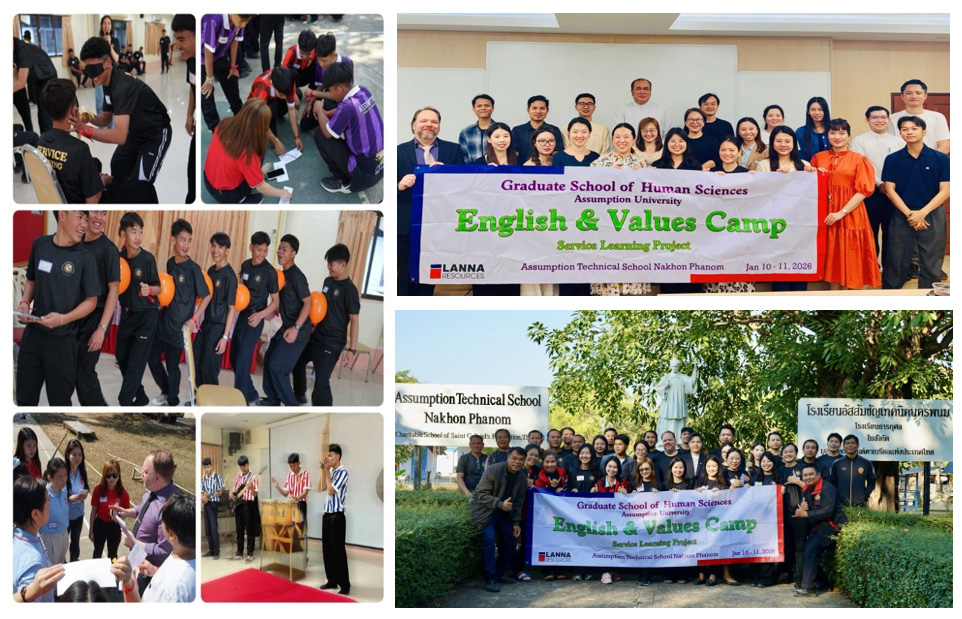
Seminar in Teacher Educational Ethics; Seminar in Educational Administration and Leadership | Graduate School of Human Sciences courses with a service-learning component on quality education and inclusion. In January 2026, 19 students designed and ran an English and Values Camp for pupils at Assumption Technical School Nakhon Phanom, applying course content to an under-resourced school community (SDG 4, SDG 10). |
|
LLB 4804 |
Law of Personal Data Protection | Law course on personal data protection and the right to privacy, supporting accountable and transparent institutions (SDG 16). Students applied the course by assisting and presenting at AU’s PDPA readiness training for about 100 administrators, faculty and staff on 19 February 2026. |
Full degree. The Bachelor of Business Administration, major in Sustainable Business Management (Martin de Tours School of Management and Economics), is a full undergraduate degree dedicated to sustainability (SDG 8, SDG 12).
Reference: Bachelor of Business Administration in Sustainable Business Management (SBM)
Bachelor of Business Administration in Sustainable Business Management (SBM)
Environmental, Social, and Corporate Governance (ESG) is now a must-have factor in running businesses due to a shift in societal expectations, regulatory changes, and a growing recognition of the link between business success and well-being of stakeholders.
- Energy: Renewable and clean energy sources
- Manufacturing: Responsible manufacturing and waste reduction
- Food and beverages: Sustainable agriculture and responsible sourcing of raw materials
- Consumer goods: Responsible marketing
- Banking: Responsible lending and investment
Dedicated courses, Academic Year 2025. In addition to the courses above, 28 courses in the Academic Year 2025 course list address sustainability or the SDGs directly in their content, across six faculties and at both undergraduate and graduate levels.
Loading Viewer...
Courses focused on specific SDGs. A further 8 courses are dedicated to a single SDG, such as human rights and the rule of law (SDG 16), diversity and inclusion (SDG 5, SDG 10), social entrepreneurship (SDG 1, SDG 8) and health policy (SDG 3).
|
Course ID |
Course Name | Faculty | Level |
SDGs |
|
BEN4316 |
Social Entrepreneurship | Business Administration | Undergraduate |
1, 8, 10 |
|
BIE3407 |
Social Entrepreneurship | Business Administration | Undergraduate |
1, 8, 10 |
|
MM8803 |
Cross Cultural, Diversity and Inclusion Management and Development | Graduate School of Business and Advanced Technology Management | Graduate |
5, 10 |
|
OD9109 |
Organization Culture, Diversity and Inclusion Management and Leadership | Graduate School of Business and Advanced Technology Management | Graduate |
5, 10 |
|
LL4104 |
Human Rights, Good Governance, Rule of Law and Ethics | Law | Undergraduate |
16 |
|
LLB1402 |
Constitution Law, Human Rights, and Political Institutions | Law | Undergraduate |
16 |
|
LLB4103 |
Fundamental Principles of Human Rights, Good Governance, Rule of Law and Ethics | Law | Undergraduate |
16 |
| HWM8001 | Healthcare and Wellness Policy, Economics, and Strategic Leadership | Nursing Science | Graduate |
3 |
Reference: Course list (TQF3), Academic Year 2025, Assumption University (internal document)
17.4.3 Education for SDGs in the wider community
Under clause 2.2 of University Announcement No. 5/2568, AU promotes lifelong learning on sustainability for people of all ages beyond its enrolled students. In Academic Year 2025, AU ran at least eighteen outreach activities that taught sustainability, health and SDG skills to school pupils, teachers, entrepreneurs, alumni and community members. The activities are grouped below by audience: alumni and the local community.
Alumni
AU opens its outreach activities to alumni as lifelong learners and partners in sustainability education.
Waves of Arts, Crafts, and Cultures: a 40th anniversary festival for alumni and the community
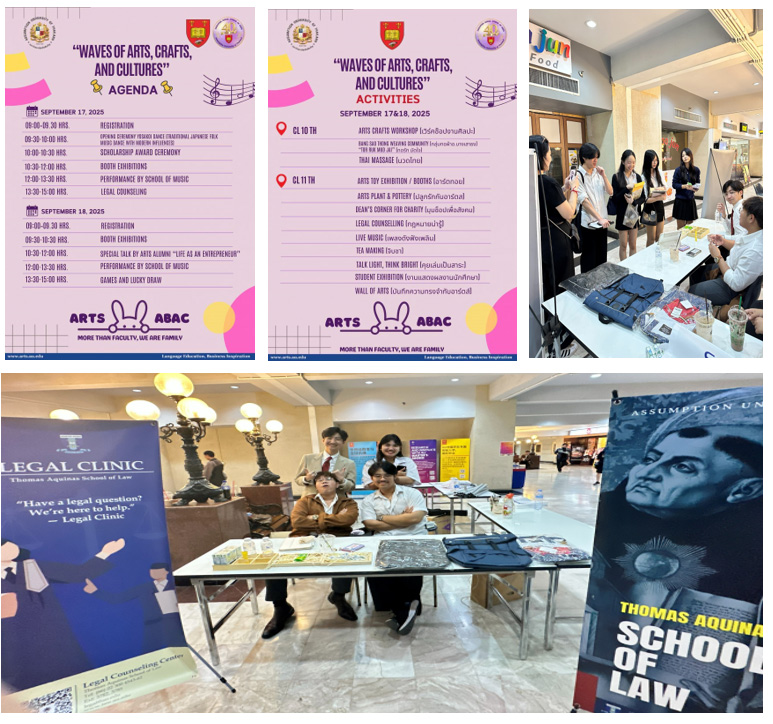
On 17–18 September 2025, the Theodore Maria School of Arts celebrated its 40th anniversary with “Waves of Arts, Crafts, and Cultures” at Suvarnabhumi Campus. The event was open to alumni, nearby schools and the Bang Sao Thong community as well as students from 11 AU schools, and offered creative workshops, exhibitions, cultural and educational activities, free legal counseling and a talk on “Life as an Entrepreneur”. Outstanding pupils from Pak Klong Chuad Yai School received scholarships, and part of the proceeds was donated to the Watthana Niwat Foundation and the Camillian Home for Children Living with Disabilities (SDG 4, SDG 10, SDG 11, SDG 17).
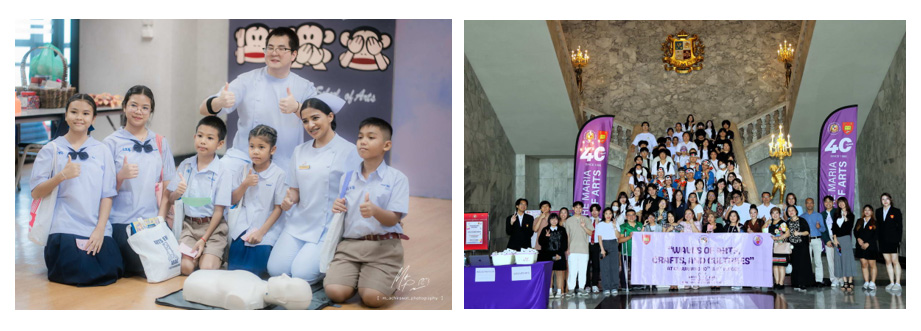
Reference: Waves of Arts, Crafts, and Cultures Raised Spirits and Support for the Community.
Local community
Most of AU’s outreach serves schools, teachers, entrepreneurs, community enterprises and residents in Samut Prakan, Bangkok and the provinces, as well as vulnerable groups such as children in foundations and older adults.
AU Earth Hero and the Recycled Materials Invention Contest
The Institute for Research and Academic Services (IRAS), the Albert Laurence School of Communication Arts, Student Affairs and the Central Library worked with Pak Klong Chuad Yai School on AU Earth Hero, which taught pupils the 3Rs and energy saving through team games and hands-on activities, and on a Recycled Materials Invention Contest judged in two age categories. AU left the school with energy conservation campaign materials and equipment to continue the work (SDG 7, SDG 12, SDG 13, SDG 17).
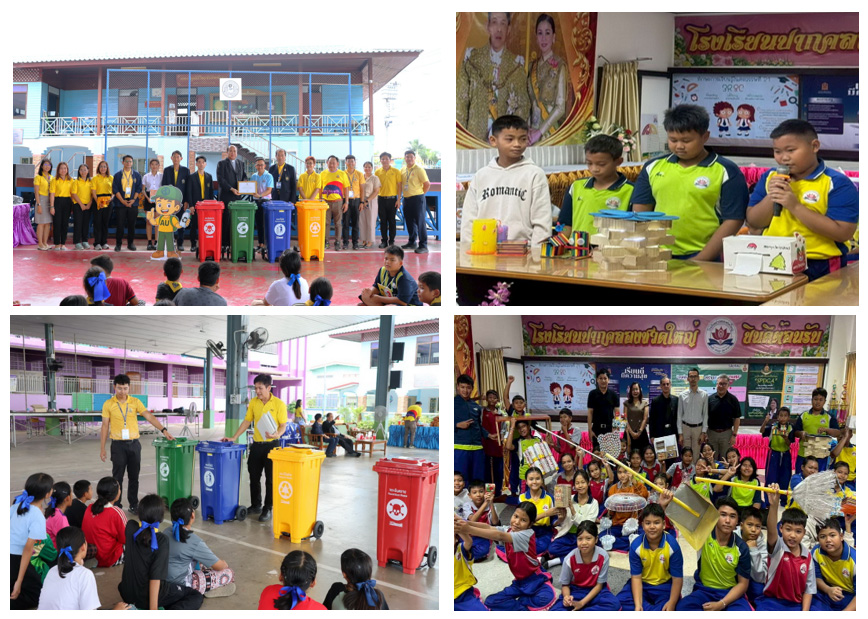
Reference: AU Earth Hero: AU Inspires Young Conservationists
Reference: Rethink, Reuse, Reward: Young Innovators Give Trash a Second Chance
Future Food Innovation Junior Competition 2025
On 17 October 2025, 43 finalist teams of school students from across Thailand presented sustainable, market-ready “future food” products to a panel of academic and industry experts at the Hua Mak Campus (SDG 2, SDG 4, SDG 12, SDG 17).
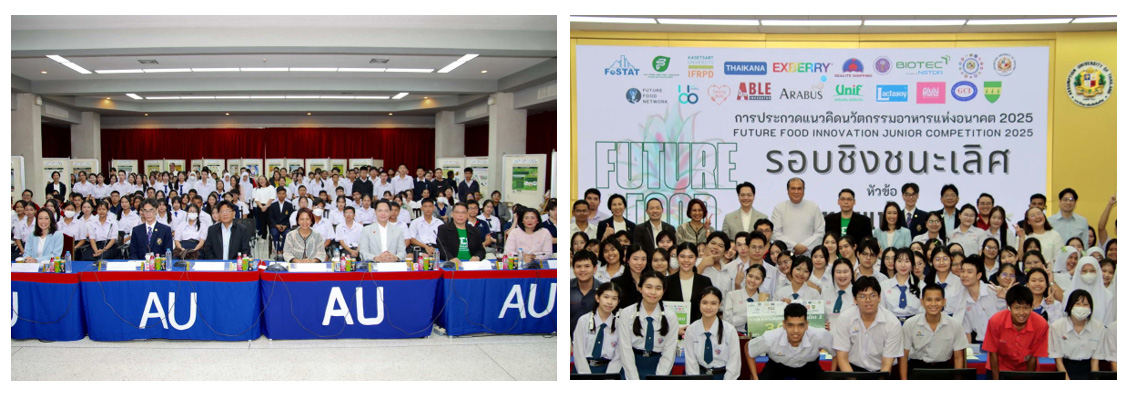
Junior-Sci Conference: Future Food for Sustainability 2025
On 16 October 2025, the Theophane Venard School of Food Biotechnology and Innovation opened its Junior-Sci Conference to secondary school students and teachers from schools across Thailand. Pupils learned to carry out and communicate research on sustainable food by presenting projects and posters in three tracks: future food for sustainability, packaging innovations for the future of food, and sustainable and biodegradable food materials. AU academics and industry experts gave feedback, six school teams received awards, certificates and cash prizes, and the School published an e-book of abstracts as a learning resource (SDG 2, SDG 4, SDG 12, SDG 17).
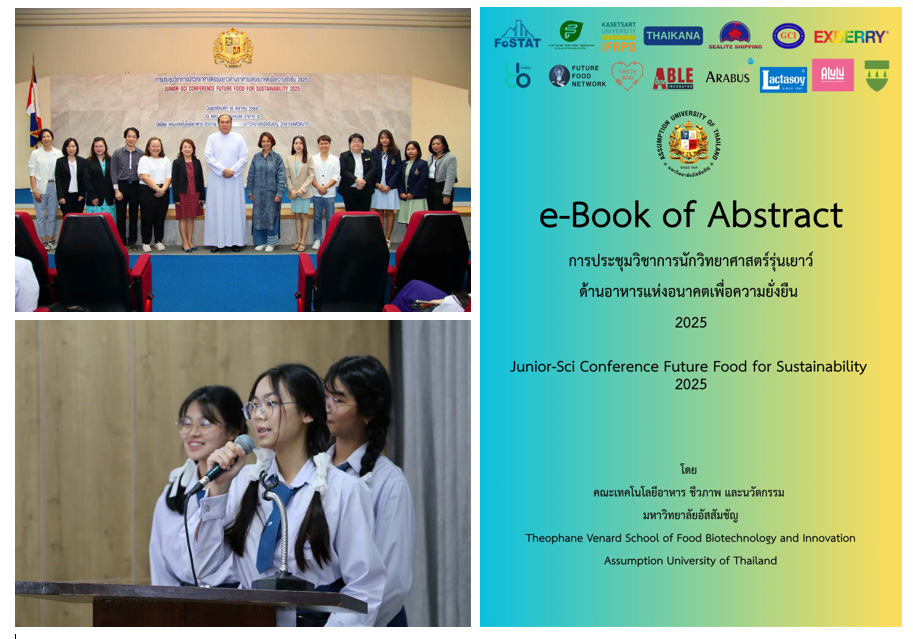
Reference: Young Innovators Take the Stage at AU’s Junior-Sci Conference
Reference: E-Book of Abstract: Junior-Sci Conference Future Food for Sustainability 2025
First aid training for primary school teachers
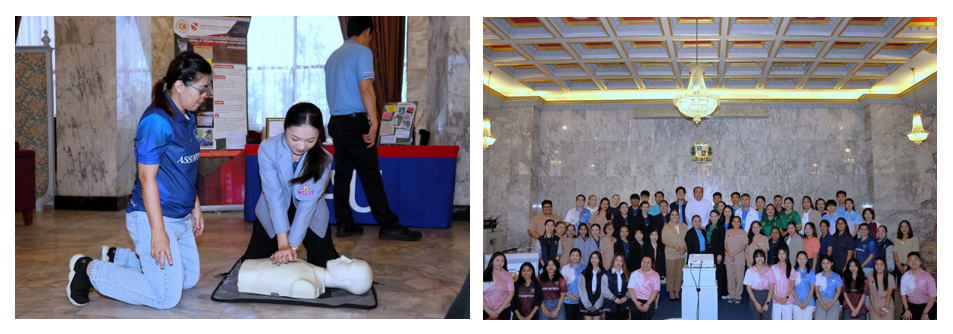
On 17 October 2025, the Bernadette de Lourdes School of Nursing Science and IRAS trained 30 primary school teachers from communities around Suvarnabhumi Campus in first aid through five hands-on stations, as part of the School’s 40th anniversary (SDG 3, SDG 4, SDG 17).
English and Values Camp, Nakhon Phanom
On 10–11 January 2026, 19 graduate students of the Graduate School of Human Sciences ran an English and Values Camp at Assumption Technical School Nakhon Phanom as a service-learning project (SDG 4, SDG 10, SDG 17).
Project Leaders: Asst. Prof. Dr. Poonpilas Asavisanu and Dr. Timothy Scott, Graduate School of Human Sciences
Recycled bottle brooms with a community enterprise
On 23 August 2025, students and faculty of the Martin de Tours School of Management and Economics worked with the Environmental Conservation Community Enterprise Group in Pathum Thani to turn used plastic bottles into marketable cleaning products that generate community income (SDG 8, SDG 12, SDG 17). The visit was part of AU’s Youth Volunteer Project 2025, supported by the Office of the Permanent Secretary, MHESI, in which faculty and students from three schools supported three community enterprises in Pathum Thani and Lat Krabang with product development, marketing, branding and basic accounting (10–11 July 2025).
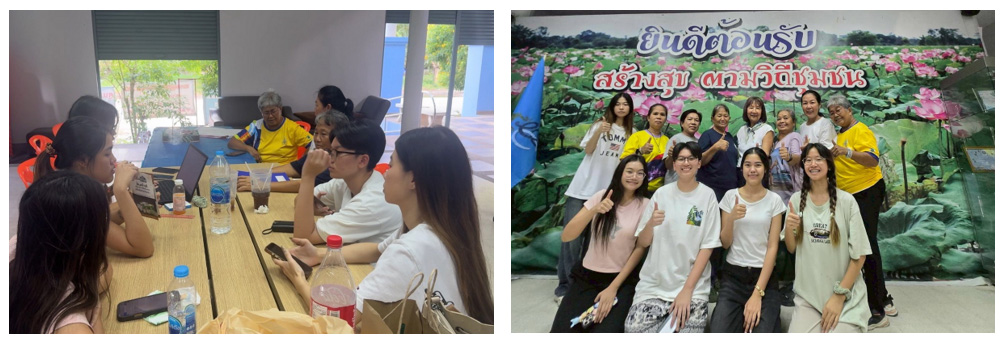
Reference: Sweeping Change: MSME Students Turn Plastic Bottles into Broom
Free legal counseling for students and the public
On 17 September 2025, the Legal Counseling Center of the Thomas Aquinas School of Law ran a free legal advice booth for students and members of the public at the “Waves of Arts, Crafts, and Cultures” event in the CL Building, Suvarnabhumi Campus. Law students, supervised by faculty, answered legal questions and raised awareness of rights and access to justice (SDG4, SDG16, SDG17).
ALSA AU Talk 2025: public dialogue on juvenile justice
On 16 February 2026, the Assumption University chapter of the Asian Law Students’ Association (ALSA AU), with the Thomas Aquinas School of Law, held ALSA AU Talk 2025 on the topic “Why Juvenile Offenders Should Face the Same Punishment as Adults.” The talk took place in the auditorium at Hua Mak Campus and was streamed live online, opening the discussion on juvenile justice, children’s rights and fair criminal justice policy to students and the wider public (SDG 4, SDG 16, SDG 17).

Reference: Thomas Aquinas School of Law: ALSA AU Talk 2025, activity record and photographs, 16 February 2026
Food safety and digital innovation training for food entrepreneurs
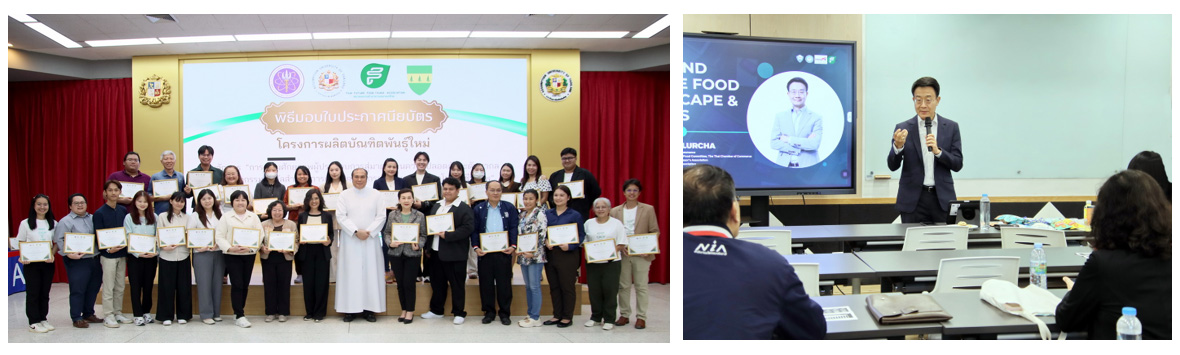
In collaboration with the Ministry of Higher Education, Science, Research and Innovation and the Thai Future Food Trade Association, the Theophane Venard School of Food Biotechnology and Innovation ran the programme “Enhancing Entrepreneurs’ Capacity towards International Food Safety Standards through Digital Innovation in Food Industry Production and Biotechnology”, which gave participants knowledge and practical skills in food safety, biotechnology and digital innovation. Certificates were presented on 27 September 2025 at a ceremony that included a keynote on “Thai Future Food Trends” by Dr. Visit Limlurcha, President of the Thai Future Food Trade Association (SDG 2, SDG 4, SDG 8, SDG 9, SDG 12, SDG 17).
Co-Creation Public Art with the Bang Sao Thong community
From 25 July to 1 August 2025, the Public Art Academic and Community Service Project “Co-Creation Public Art for Wellbeing and Cultural Exchange” brought together graduate students of the M.A. in Art and Design programme, faculty members and local residents of Bang Sao Thong District, Samut Prakan. Under the theme “Art for Wellbeing, Culture for Community”, residents and students co-created four public artworks reflecting local cultural identity, engaging residents in how public art can support community wellbeing, cultural exchange and the local creative economy (SDG 4, SDG 11, SDG 17).
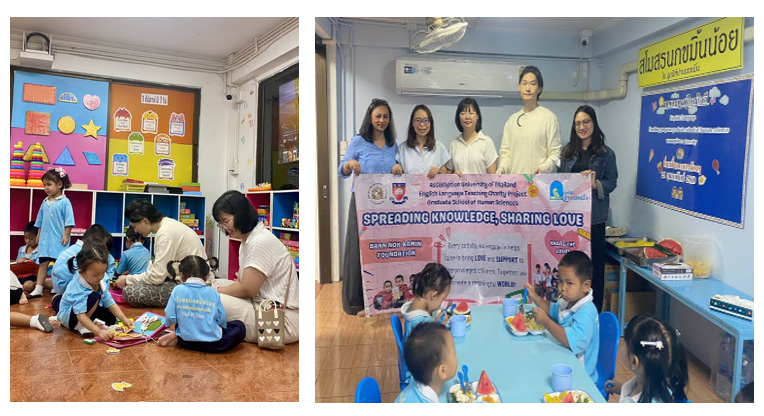
Sharing Knowledge, Spreading Love: English learning for children at Baan Nok Kamin Foundation
On 25 February 2026, the English Language Teaching (ELT) Program, Graduate School of Human Sciences, ran its second charity project at the Baan Nok Kamin Foundation. MA ELT students, led by Dr. Marilyn Deocampo and Asst. Prof. Dr. Rosukhon Swatevacharkul, taught children English through interactive conversation activities and provided a free lunch, funded by ELT booth activities at the IELE Language Café (SDG 4, SDG 10, SDG 17).
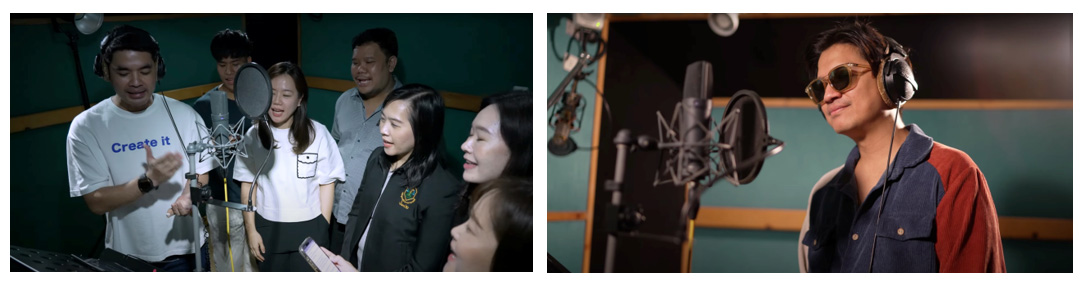
“Don’t Call It Old, Just Grown Up”: music for an ageing society
On 17 August 2025, the Louis Nobiron School of Music, with King Prajadhipok’s Institute and the Medical Council of Thailand, held a public concert at Paradise Park Shopping Center under the research project “Thai Culture-Based Innovative Music Therapy for Aging Society.” Four original songs representing four regions of Thailand were created to promote older adults’ well-being and understanding between generations (SDG 3, SDG 10, SDG 17)
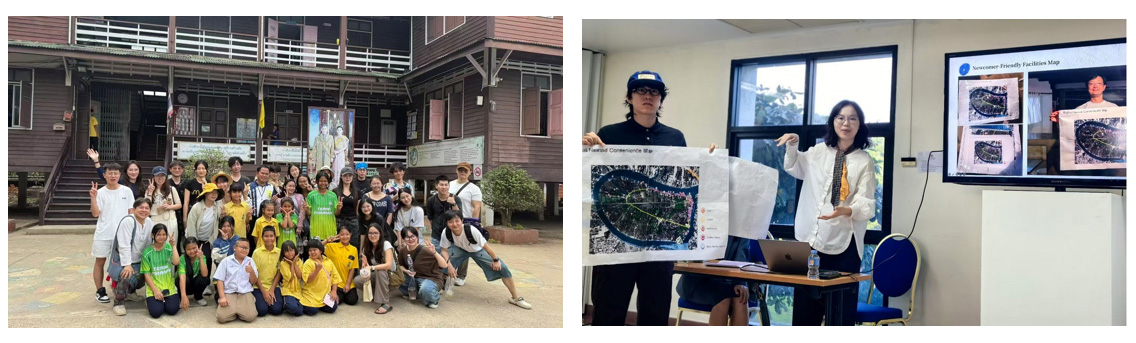
Global Youth Rural Creative Residency, Koh Kret
From 19 to 26 January 2026, AU and Peking University ran a residency on Koh Kret, Nonthaburi, in which faculty, students and young creators worked with the local community on sustainable rural development. Outcomes included cycling and commercial maps, a cultural “Travel Passport”, homestay improvements and locally inspired ceramic products, and the residency included art-therapy activities for local primary school pupils (SDG 4, SDG 11, SDG 12, SDG 17).
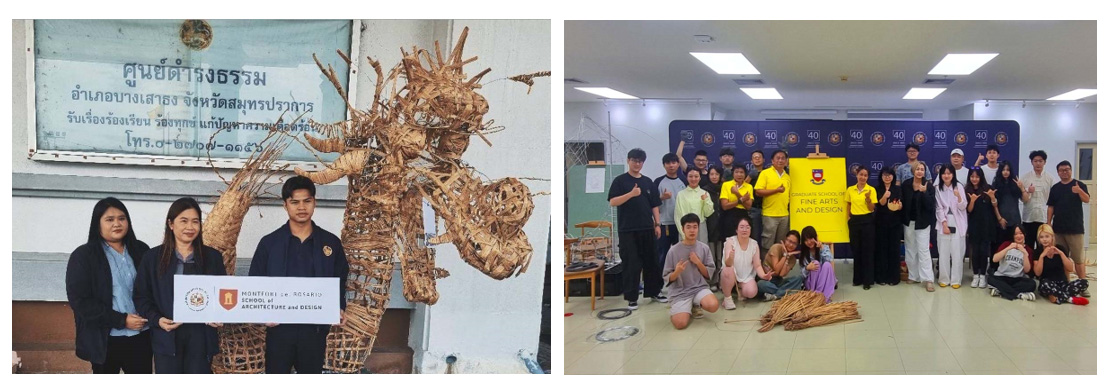
Thai Art and Culture Promotion Program: Community Education on Cultural Heritage for Youth Nationwide
From 21 to 25 October 2025, Assumption University (AU) partnered with the Ruamchit-Normklao Foundation (for Youth) under Her Majesty’s Royal Patronage to deliver the 10th Thai Art and Culture Promotion Program. The program is an outreach educational activity for young people outside the university: scholarship recipients from every province of Thailand.
Hosted at AU’s Suvarnabhumi Campus and at cultural and historical sites in Bangkok and nearby provinces, the program combined experiential learning visits with structured education sessions. Participants visited heritage sites such as the Grand Palace and Wat Phra Kaew, Wat Pho, Wat Arun, Wat Suthat, Museum Siam and the Ancient City (Muang Boran). AU then facilitated group learning and reflection sessions that developed teamwork, critical thinking and an understanding of youth’s role in preserving cultural identity. AU’s President, faculty members and student volunteers took part in delivering the program.
The program supports SDG 11.4 by building awareness among the next generation of the need to safeguard Thailand’s tangible and intangible cultural heritage. It also supports SDG 4.7 by promoting appreciation of cultural diversity and of culture’s contribution to sustainable development. Through this ongoing partnership with a civil society foundation, now in its 10th year, AU extends education for the SDGs beyond its campus to youth across the country.
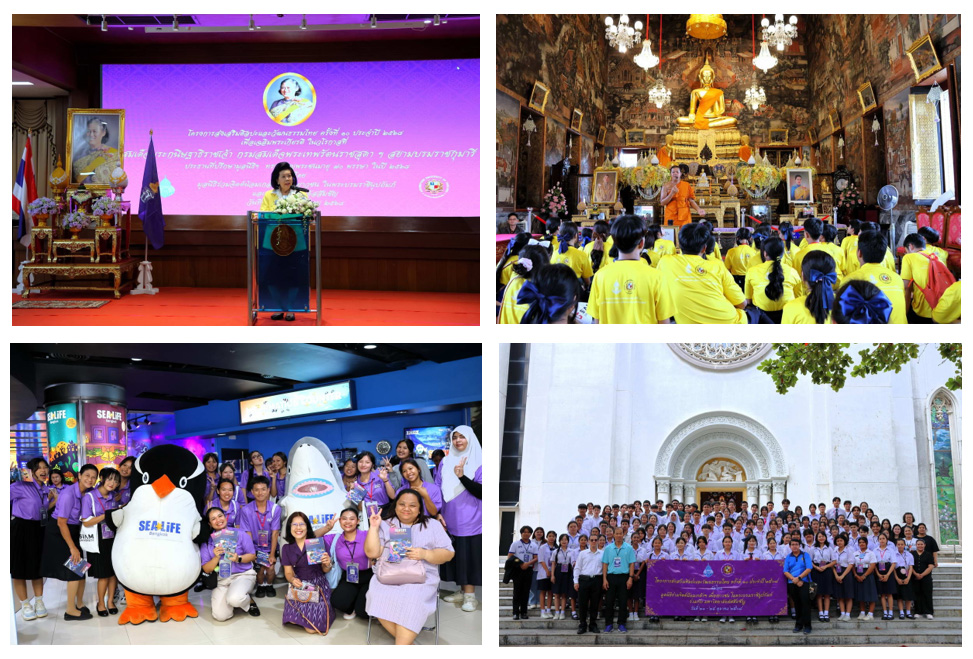
Reference: https://www.au.edu/au-partners-with-ruamchit-normklao-foundation-to-champion-thai-cultural-heritage/
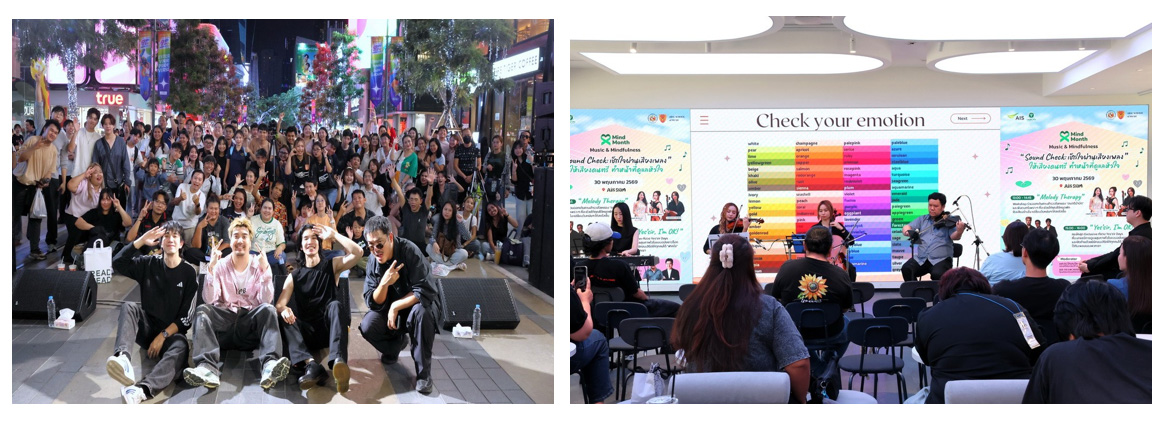
Music and mindfulness for the public at Siam Square
On 30 May 2026, the Louis Nobiron School of Music joined AIS Siam for Mind Month: Music & Mindfulness at Siam Square, a public event for young people and music audiences. It featured a “Melody Therapy” workshop on using music for mindfulness and emotional self-care, an open conversation on mental health and well-being moderated by the Dean of the School with Dr. Vorat Chotipitayasunon, spokesperson for the Ministry of Public Health, and a free mini concert at Siam Square Walking Street (SDG 3, SDG 4, SDG 17).
Mangrove Seedling and Reforestation Project
The Thomas Aquinas School of Law has run its Mangrove Seedling Project continuously since 2005. Each year, law students and staff plant mangrove seedlings and clear waste from coastal mangrove forest, learning first-hand about coastal ecosystems and climate resilience. In Academic Year 2025, the activity took place on 12–13 January 2026, continuing a programme that has now run for more than 20 years (SDG 13, SDG 14, SDG 15, SDG 17).
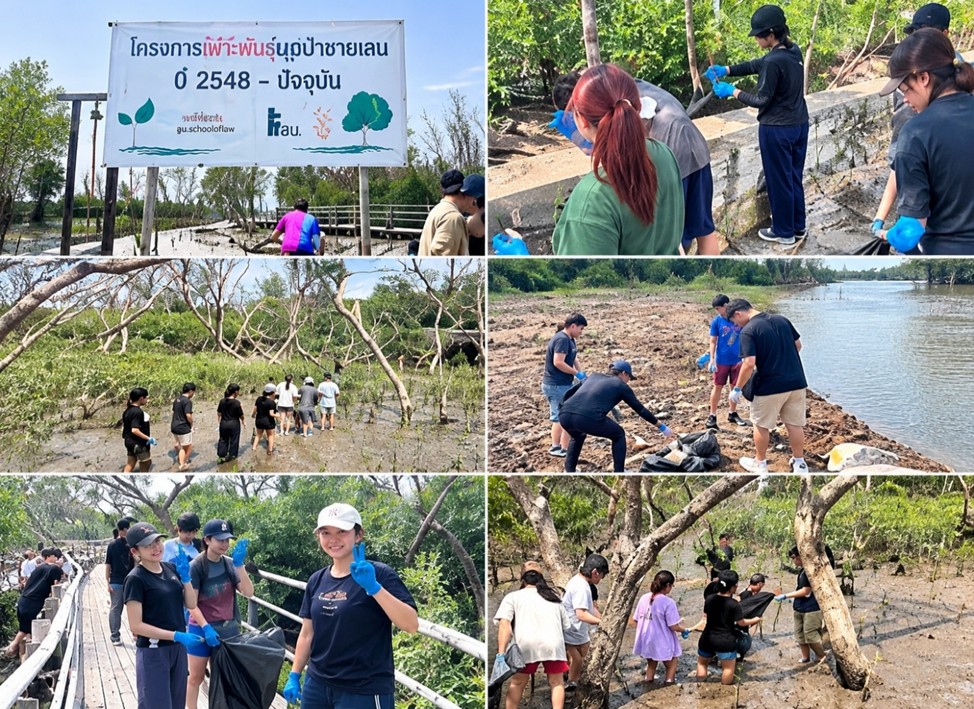
Reference: Thomas Aquinas School of Law: Mangrove Seedling Project (2005 – present), activity record and photographs, 12–13 January 2026
BLNS CSR Volunteer Spirit for Community 2026
On 18 May 2026, second-year nursing students led health education for 126 pupils at Haad Amra Aksorn Lak Wittaya School, Samut Prakan Province, through four learning stations as peer educators (SDG 3, SDG 4, SDG 17).
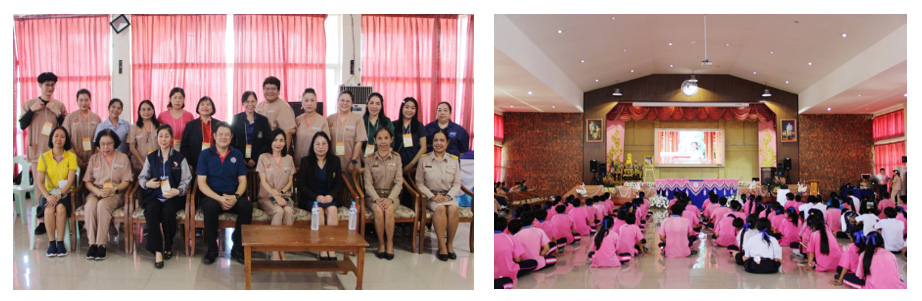
Reference: https://sustainability.au.edu/report/
SDGs Knowledge Sharing videos and online SDG knowledge test
AU’s sustainability website offers the public an SDGs Knowledge Sharing series of four videos: sustainable development, the Sustainable Development Goals, things to know before implementing the SDGs, and SDGs mapping (the last provided by UNDP and used with permission). Visitors are invited to watch the series and complete a short online SDG knowledge evaluation, so anyone, including alumni and community members, can learn about the SDGs and test their understanding (SDG 4, SDG 17).
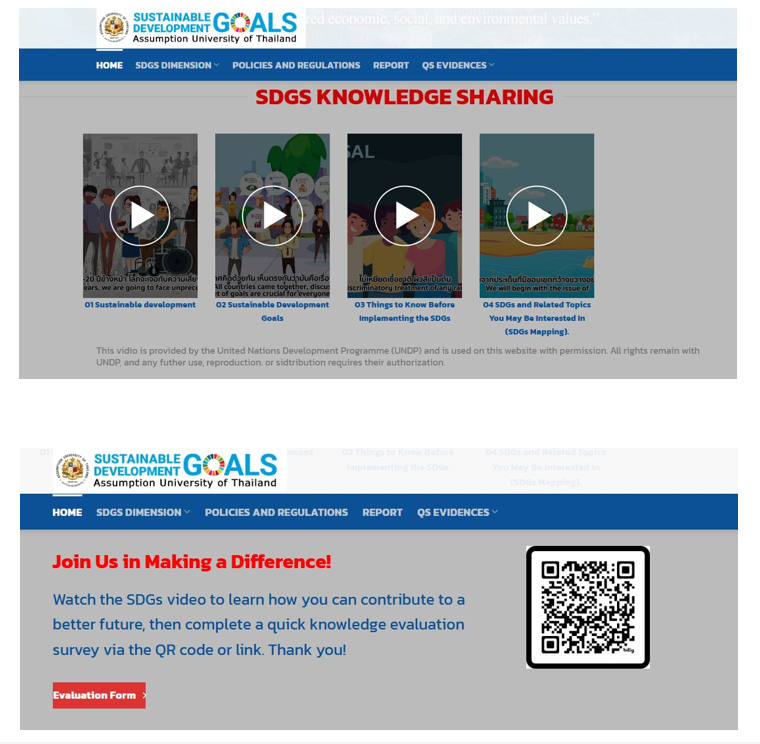
Reference: AU Sustainable Development Goals website: SDGs Knowledge Sharing
Reference: SDGs Knowledge Evaluation Form
17.4.4 Sustainable Literacy
AU builds sustainability literacy among students and staff through co-curricular activities in six areas. The table summarises Academic Year 2025 activities by literacy area.
|
Literacy area |
Academic Year 2025 activities |
Participants |
|
Environmental literacy |
Guest lecture “Bold Ideas for a Fragile Planet” (4 July 2025) and “Policy Meets the Planet” session on government policies and sustainability (18 July 2025) by conservation scientist Dr. Petch Manopawitr, President of the Bird Conservation Society of Thailand; student visit to BCPG solar farm, Ayutthaya (September 2025); AU Earth Hero, in which students and staff learned and taught the 3Rs and energy saving | Students, staff, school pupils |
|
Health literacy |
Nursing students build health literacy by organizing and leading health activities: blood donation drive with the Thai Red Cross (29 August 2025); tobacco-control education exchange with the Nurse Network on Tobacco Control of Thailand; first aid training for primary school teachers (17 October 2025); peer health education for school pupils (18 May 2026) | Students; 30 teachers; 126 pupils |
|
Financial literacy |
AU and Thairath Money financial skills event with the Fin Zone (11 September 2025); Thai Investors Association (SIAT) alliance on finance and investment education (12 January 2026); staff retirement planning workshop (1 April 2026) | Students and staff |
|
Digital literacy |
AU AI Governance Forum (29 August 2025); PDPA readiness training (19 February 2026) | 20 participants; about 100 staff |
|
Ethical and social literacy |
AU Social Teaching framework integrating principles such as human dignity, solidarity and the common good into ethics education (25 March 2026); Creativity for Sustainable Solutions certificate, applying creative approaches to sustainability challenges (30 participants certified, 18 October 2025); 2030 SDGs Game with participant evaluation (9 December 2025; details below) | About 30 academic leaders; 30 certified participants; 30 graduate students |
|
Legal literacy |
ALSA AU Talk 2025 on juvenile justice and children’s rights, Hua Mak Campus and online (16 February 2026); Legal Counseling Center free advice booth raising awareness of rights and access to justice (17 September 2025) | Students and the public |
Experiential SDG learning: the 2030 SDGs Game
On 9 December 2025, the AU Library ran the 2030 SDGs Game for 30 graduate students of the Graduate School of Human Sciences. Students explored sustainable development through strategy, negotiation and reflection. The session was rated 4.76 out of 5, and all participants said they wanted to learn more about the SDGs and ESG (SDG 4, SDG 17).