


SDG 7 : Affordable and Clean Energy
Assumption University of Thailand (AU) has integrated the Sustainable Development Goals (SDGs) into its Strategic Plan for Academic Years 2023–2027 (revised for 2025–2027). In support of SDG 7 (Affordable and Clean Energy), the University has committed to carbon neutrality by 2050 and net-zero greenhouse gas emissions by 2065, backed by an Energy Management Working Group and the AU Sustainability Committee.
In Academic Year 2025, AU set a target of cutting electricity consumption by 12.50% against the Academic Year 2024 baseline. Replacing air-conditioning units and upgrading lighting across its campuses reduced total electricity use by 5.83% in 2025, with the largest savings from air-conditioning replacement (55.18%) and LED lighting (70.10%). Planned solar carport and rooftop systems are projected to save an estimated 111.5 million baht over 25 years, and a Suvarnabhumi Campus building received the MEA Energy Awards 2025 (Standard Level). AU also shares its energy expertise with schools, industry and international partners, particularly in new energy vehicles.
7.2 University measures towards affordable and clean energy
7.2.1 Energy-efficient renovation and building
Assumption University promotes energy efficiency in the planning, design, construction, and improvement of its buildings and facilities. The University incorporates energy-saving considerations into building development and renovation, while also exploring the use of clean and renewable energy technologies to reduce energy consumption and environmental impacts. These efforts are supported by relevant university policies and implemented through building and infrastructure projects that incorporate energy-efficient and sustainable design principles.
Loading Viewer...
Issued in B.E. 2552 (2009) in line with the Energy Conservation Promotion Act, the policy commits the University to develop its energy management system continuously, to improve energy efficiency using appropriate technology, to set annual targets and communicate them to personnel, to provide budget, personnel and training, and to have executives review the policy and action plan regularly.
Loading Viewer...
Issued on 1 April B.E. 2568 (2025), the policy requires sustainable energy management through energy-saving measures and the promotion of clean and renewable energy. It also calls for expanding green space under the vision of a “University as a Forest Park”, which indirectly reduces the heat load on buildings.
Order No. 37/2025 on the Appointment of the Energy Management Working Group within Assumption University of Thailand
Order No. 37/2025 (B.E. 2568), dated 17 March 2025, appoints a new Energy Management Working Group covering both the Huamark and Suvarnabhumi campuses. It replaces the group formed under Order No. 42/2021 and supports compliance with the 2009 Ministerial Regulation on energy management in controlled factories and buildings.
Composition: 15 members chaired by the Vice President for Administration, drawn from academic, legal, student affairs, library, HR, finance, procurement, IT, facilities (both campuses), operations and maintenance, technical, and legal and administrative units, with one member serving as secretary.
Key duties
- Manage energy in line with the university’s energy conservation policy
- Coordinate with all units and organize training or conservation activities
- Monitor energy-use data and status, and each unit’s performance
- Report results to the university, and review the policy with recommendations for improvement
- Support the university’s compliance with energy-related laws
Loading Viewer...
7.2.2 Upgrade buildings to higher energy efficiency
Assumption University is committed to enhancing energy efficiency across its buildings through building improvement plans and energy conservation measures. The University has developed an improvement plan that identifies the target buildings and areas for implementation and establishes specific electricity consumption reduction targets. These initiatives aim to improve building energy performance and support the University’s broader objectives of energy conservation and sustainability.
In this regard, Assumption University has set a target of reducing electricity consumption by 12.50% compared with the academic year 2024 baseline, with a particular focus on air-conditioning and lighting systems, which account for the largest shares of the University’s total electricity consumption.
Electrical energy conservation plan, B.E. 2568
Assumption University has established four key measures to enhance energy efficiency across its buildings and reduce electricity consumption in line with its established targets. These measures focus on improving the efficiency of systems and equipment that account for a substantial proportion of the University’s overall energy consumption, while promoting efficient energy use and systematic energy management. The measures are designed to support the University’s target of reducing electricity consumption by 12.50% compared with the 2024 baseline, while improving building energy performance and mitigating environmental impacts over the long term. The four measures, together with their respective implementation approaches and associated targets, are summarized in Table 1.
Table 1. Electrical energy conservation measures, B.E. 2568
|
Measure |
Implementation period | Electricity Consumption Before Measures (kWh/year) |
Electricity Consumption After Measures (kWh/year) |
| 1) Air Conditioning Replacement: Replacement of 85 air-conditioning units in university offices and classrooms. |
Jun–Aug 2025 |
1,271,096.40 | 684,677.00 |
|
2) Student Dormitory Air Conditioning Replacement: Replacement of 337 air-conditioning units that have been in use for over 15 years. |
March–Dec 2025 |
1,614,604.00 |
608,830.00 |
|
3) Lighting Fixture Improvement: Improvement of 120 lighting fixtures in corridors, classrooms, and offices. |
July–Sep 2025 |
24,040.80 |
9,072.00 |
|
4) LED Lighting Replacement: Replacement of 2,130 existing lights with energy-efficient 8W, 13W and 18W LED Ecofit T8 tube lights in classrooms and faculty offices. |
Jan 2024 – Dec 2025 | 164,001.60 |
47,157.60 |
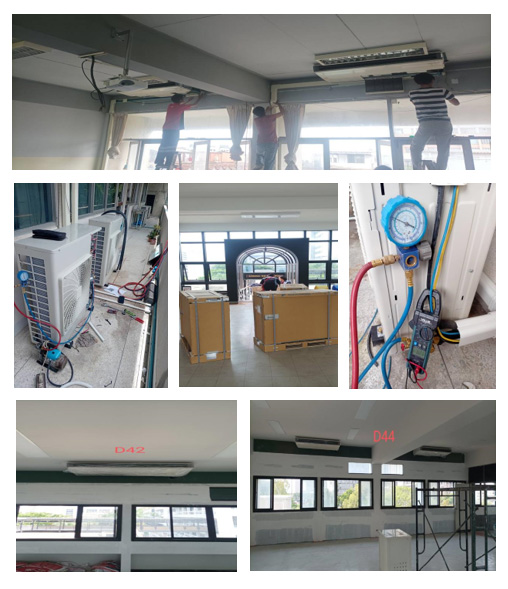
Measure 1: Air Conditioning Replacement: Replacement of 85 air-conditioning units in university offices and classrooms.
An inspection of the air-conditioning systems at Assumption University’s Hua Mak Campus revealed that the existing units had been in operation for more than 30 years. These aging units frequently experienced operational failures, consumed excessive electricity, and provided insufficient cooling performance. To improve energy efficiency, the University replaced the existing units with 85 Daikin air-conditioning units across several locations: 38 units in Building D, 8 units on the first floor of the Library Building, 33 units serving classrooms on floors 1–5 of Building P, and 6 units on the second floor of Building M.
The estimated annual electricity consumption for these areas decreased from 1,271,096.40 kWh to 684,677 kWh following the replacement, resulting in annual electricity savings of 586,418.94 kWh, equivalent to approximately 46.13%. This initiative demonstrates the University’s commitment to improving energy efficiency, reducing electricity consumption, and promoting sustainable energy management across its campus.
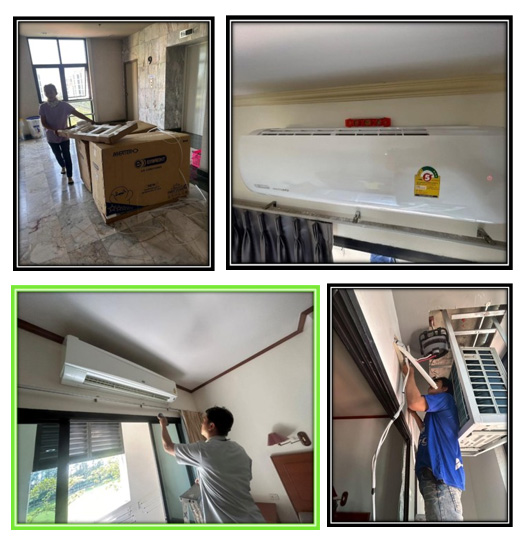
Measures 2: Student Dormitory Air Conditioning Replacement: Replacement of 337 air-conditioning units that have been in use for over 15 years.
Assumption University operates student dormitories equipped with split-type air-conditioning units, comprising 73 units in Building A, 128 units in Building B, and 136 units in Building C, for a total of 337 units. These air-conditioning units had been in service for more than 20 years.
The University’s Energy Conservation Team assessed the performance of the existing air-conditioning units and found that their average Energy Efficiency Ratio (EER) was only 6.91, indicating relatively low energy efficiency and high electricity consumption. In response, the University initiated a replacement project to install air-conditioning units with higher energy efficiency. Priority was given to units with the lowest efficiency and those showing signs of deterioration or malfunction.
The project covered the replacement of all 337 air-conditioning units in Buildings A, B, and C, specifically on floors 7, 8, and 9. This initiative aims to improve energy efficiency, reduce electricity consumption, and support the University’s commitment to effective and sustainable energy management. Following the replacement of the air-conditioning units, annual electricity consumption was reduced from 1,614,604 kWh to 608,830 kWh, resulting in annual electricity savings of 1,005,774 kWh, or approximately 62.29%.
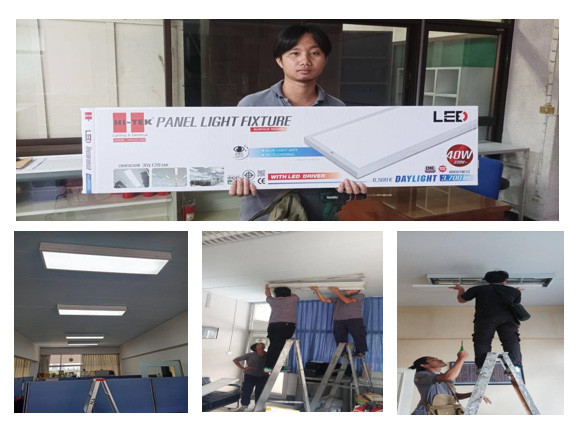
Measures 3 : Lighting Fixture Improvement: Improvement of 120 lighting fixtures in corridors, classrooms, and offices.
An inspection of the University’s existing lighting system revealed that the conventional 2 × 36 W fluorescent fixtures, commonly known as batten-type fixtures, consumed relatively high amounts of electricity, while some components of the lighting circuits had begun to deteriorate. To improve energy efficiency, the University replaced the existing fixtures with 120 LAMTON LED panel lights, each rated at 40 W and measuring 30 × 120 cm.
The replacement covered several locations, including the cooperative store, the secretary’s office in Building D2, the office in Building A3, the office in Building M1, Classroom E64, the Building Management Office in Building E1, and the area in front of the elevator in Building M2.
This initiative aims to improve the energy efficiency of the University’s lighting system, reduce electricity consumption, and upgrade lighting equipment to better meet operational requirements. The actual energy savings can be evaluated based on the rated power consumption of the original and replacement fixtures, together with their respective operating hours. Following the implementation of this measure, electricity consumption decreased from 24,040.80 kWh to 9,072 kWh, resulting in annual electricity savings of 14,968.8 kWh, or approximately 62.26%.
Measures 4: LED Lighting Replacement: Replacement of 2,130 existing lights with energy-efficient 8W, 13W and 18W LED Ecofit T8 tube lights in classrooms and faculty offices.
Assumption University has continuously implemented energy conservation measures, with a particular focus on reducing electricity consumption in academic buildings and work areas. One of its key initiatives is the gradual replacement of conventional fluorescent lamps with energy-efficient LED lighting, which provides adequate illumination while reducing electricity consumption. In the long term, the University aims to transition entirely to LED lighting across all areas to improve energy efficiency and achieve sustained reductions in electricity use.
Following the implementation of this measure, annual electricity consumption decreased from 164,001.60 kWh to 47,157.60 kWh, representing an annual energy saving of 116,844 kWh, or approximately 71.25%. The details of implementation at the University’s two campuses are presented below.
- Suvarnabhumi Campus
Engineering and Music Building: The University replaced conventional 36 W fluorescent lamps, which had been in service for approximately 15–20 years or longer and were used for an average of seven hours per day, with 13 W LED T8 lamps, totaling 2,000 lamps. Of these, 1,200 lamps were installed in classrooms on floors 2–11 of the Engineering Building, while 800 lamps were allocated to the Music Faculty. This initiative aims to improve energy efficiency, reduce electricity consumption, and maintain appropriate illumination levels for learning and other activities. Fluorescent lamps that remain in good working condition are reused in other buildings where this type of lighting is still in use, thereby minimizing resource waste and promoting efficient resource utilization.
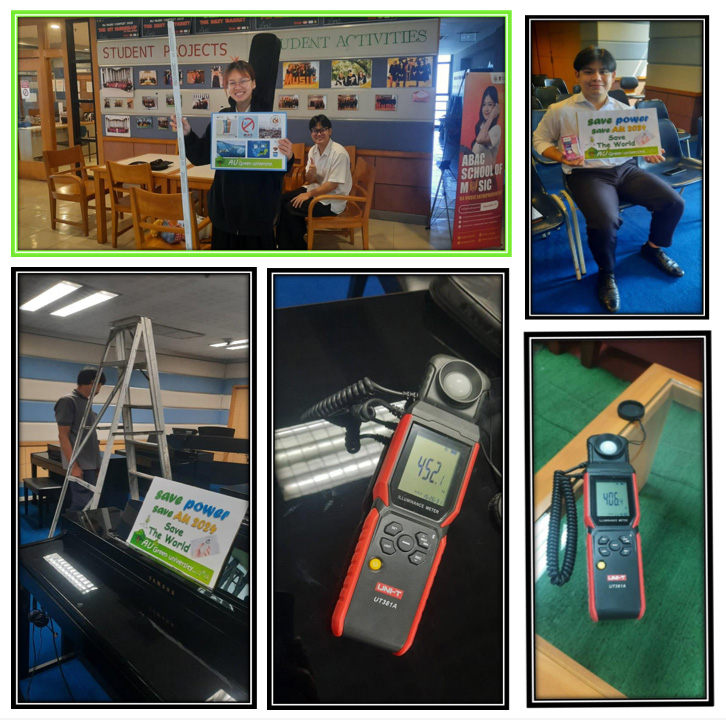
- Hua Mak Campus
An inspection of the lighting systems in classrooms, corridors, and offices revealed that the existing lamps consumed relatively high amounts of electricity and that some circuit components had deteriorated. To improve energy efficiency, the University replaced the existing lamps with 103 LED Ecofit T8 tube lights rated at 18 W and 27 LED Ecofit T8 tube lights rated at 8 W.
These initiatives demonstrate the University’s commitment to improving energy efficiency, reducing electricity consumption, and making effective use of resources. In addition to adopting more energy-efficient lighting technologies, the reuse of serviceable fluorescent lamps in other buildings helps minimize resource waste and supports the University’s broader commitment to sustainable energy management.
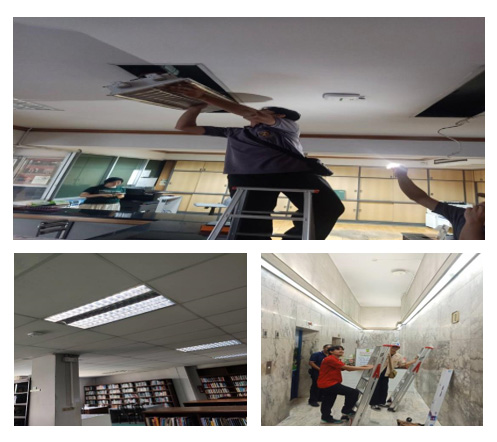
In addition to its existing energy-saving measures, Assumption University of Thailand plans to retrofit existing buildings and facilities to generate electricity from solar energy, through Solar Carport and Solar Rooftop systems on both campuses. These initiatives aim to enhance the energy efficiency of the University’s buildings and facilities, reduce electricity costs, and support the University’s Net Zero goal, in alignment with Sustainable Development Goal 7 (Affordable and Clean Energy). The projects are implemented under a 15-year power purchase agreement, and upon its expiration, ownership of all equipment will be transferred to the University. The details are as follows:
- Solar Carport: Suvarnabhumi Campus
The university plans to build a new parking building equipped with a Solar Carport system in the parking area in front of the Gymnasium. The project is intended to provide a parking facility for the university’s students and staff, with space for 400 cars. The benefits of this building are:
1.1 Clean energy: uses solar energy instead of fossil fuels.1.2 Environmentally friendly: reduces greenhouse gas emissions and supports the Net Zero goal.1.3 Greater use of parking space: the roof provides shade and rain protection, a welfare benefit for students.
1.4 Electricity generated for use within the university: reduces electricity costs, and the energy can be used for the university’s buildings and various systems.
1.5 Learning resource: for energy and sustainability education.
Loading Viewer...
The installation of the Solar Carport system is expected to help Assumption University reduce electricity costs over the 25-year project lifetime. The estimated cumulative savings reflect the anticipated reduction in electricity expenses through the use of solar energy, contributing to long-term cost efficiency and the University’s commitment to sustainable energy management.
|
Period |
Savings |
|
Years 1-15 (contract period) |
24.8 million baht |
|
Years 16-25 (post-contract) |
53.2 million baht |
| Net 25-year savings |
78.0 million baht |
- Solar Rooftop: Hua Mak Campus
Huamark Campus has relatively limited space. Therefore, installing a solar power generation system requires making efficient use of vacant space on buildings without affecting the usable areas below. A Solar Rooftop installation is thus the most suitable option. The buildings planned for solar cell installation comprise six buildings, in order to support the efficient use of clean energy. The buildings planned for solar installation are shown in the following figures.
Loading Viewer...
The Solar Rooftop installation is projected to generate long-term financial benefits for Assumption University by reducing its reliance on grid-supplied electricity. Over the 25-year project period, the system is expected to deliver cumulative cost savings through on-site renewable energy generation, while supporting more efficient energy use and advancing the University’s commitment to environmental sustainability and carbon emission reduction.
|
Period |
Savings |
|
Years 1-15 (contract period) |
11 million baht |
|
Years 16-25 (post-contract) |
22.5 million baht |
| Net 25-year savings |
33.5 million baht |
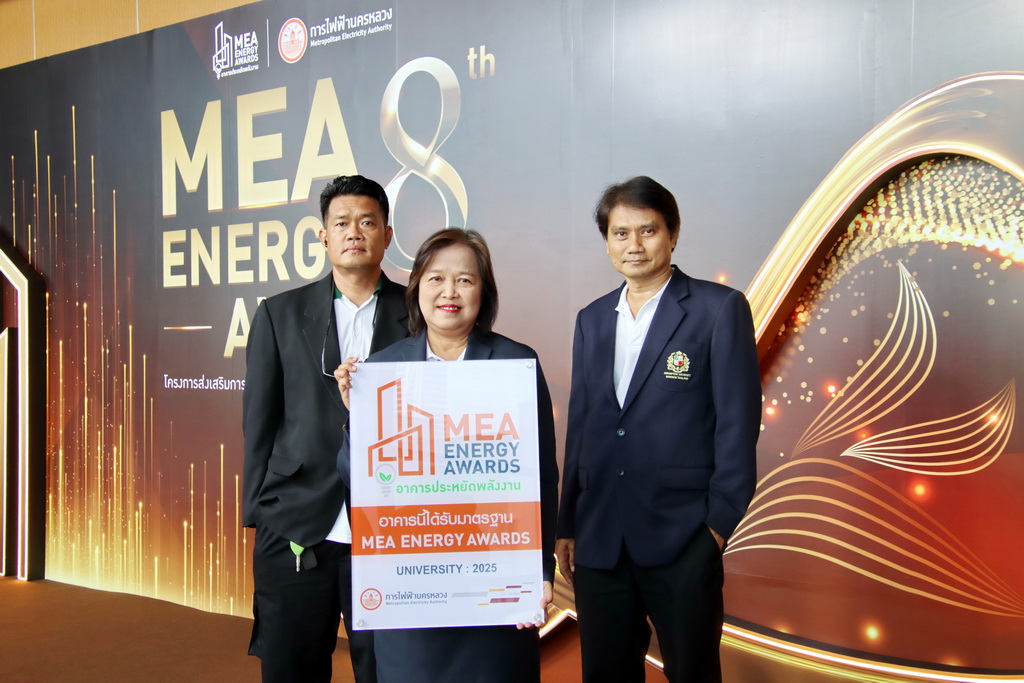
To demonstrate Assumption University of Thailand’s commitment to energy-efficient buildings and sustainable energy management, on April 27, 2026, The Assumption University of Thailand (AU) received the MEA Energy Awards 2025 – Standard Level for a building at its Suvarnabhumi Campus, recognizing its performance in energy efficiency, indoor air quality, and responsible building operations. According to the university’s official announcement, the building achieved an MEA Index score of 0.981, meeting the award’s criteria.
This recognition provides supporting evidence of AU’s commitment to energy-efficient building management and the development of a more sustainable campus environment. It supports SDG 7, by demonstrating the university’s efforts to promote energy efficiency in its buildings and maintain responsible operational practices. The award also reflects AU’s broader commitment to reducing energy waste while providing a healthy and comfortable learning environment for students and staff.
7.2.3 Carbon reduction and emission reduction process
Assumption University of Thailand has integrated carbon management and greenhouse gas reduction into its sustainability policy and strategy, with a clear commitment to supporting its Net Zero goal. The University implements these efforts systematically under the oversight of its Energy Management Working Group. Its carbon dioxide emission reduction process comprises three core measures, as follows:
- Sustainable Environmental Management Policy (Announcement No. 6/2568)
The University has established a sustainable environmental management policy, with the goals of achieving carbon neutrality by 2050 and net-zero greenhouse gas emissions by 2065. The announcement also outlines key initiatives to support implementation, including sustainable energy management, the expansion of green spaces under the concept of a “University as a Forest Garden,” and Zero Waste management.
Loading Viewer...
- AU Sustainability Committee (Order No. 36/2568)
The University has established the AU Sustainability Committee to drive the implementation of the United Nations Sustainable Development Goals (SDGs), with the following key responsibilities:
- Formulating sustainability policies and strategies.
- Coordinating and integrating sustainability initiatives across the University.
- Promoting environmental sustainability initiatives.
- Promoting social responsibility and community engagement.
- Establishing performance indicators and monitoring implementation progress.
- Overseeing sustainability data and supporting evidence.
Loading Viewer...
- Assumption University Announcement No. 16/2568 (2025) on Operational Policies for Faculties and Units, Academic Year 2568 (2025)
Assumption University of Thailand has integrated energy management and greenhouse gas reduction into its sustainability policy and strategy, with a clear commitment to supporting its Net Zero goal. These efforts are implemented systematically under the oversight of the University’s Energy Management Working Group. In support of this, the University issued Assumption University Announcement No. 16/2568 (2025) on the Operational Policies for Faculties and Units for the 2025 Academic Year, dated 17 November 2025. The announcement establishes practices that reduce energy and resource consumption and, in turn, indirectly reduce greenhouse gas emissions. The relevant measures are as follows:
3.1 Consolidation of building use (Item 2.2): Faculties and units are to consider consolidating the use of buildings and facilities so that certain buildings or floors can be closed and teaching equipment shared. This reduces electricity consumption for air conditioning, lighting, and utilities in unneeded spaces.
3.2 Balancing course sections with enrollment (Item 2.4): The number of sections is aligned with actual student enrollment, avoiding unnecessary use of classrooms and facilities, so that energy use corresponds to actual demand.
3.3 Economical use of resources and utilities (Item 3.1): Personnel are urged to use work materials, equipment, and utilities economically, reducing electricity and resource use in daily operations.
3.4 Reduction of unnecessary expenditure (Item 1.2) and postponement of non-urgent procurement (Item 3.2): These measures promote efficient use of resources and limit unnecessary consumption.
Loading Viewer...
In addition to the measures mentioned above, Assumption University is committed to reducing carbon emissions and minimizing environmental impacts through its energy conservation policy and practical carbon reduction measures. The University has implemented various projects to support its carbon reduction and greenhouse gas emission reduction objectives, as follows.
AU Community Plants Trees in Celebration of the King’s Birthday
Reference: https://repository.au.edu/items/d6911604-767a-4964-b9e8-35c6936e9a1c
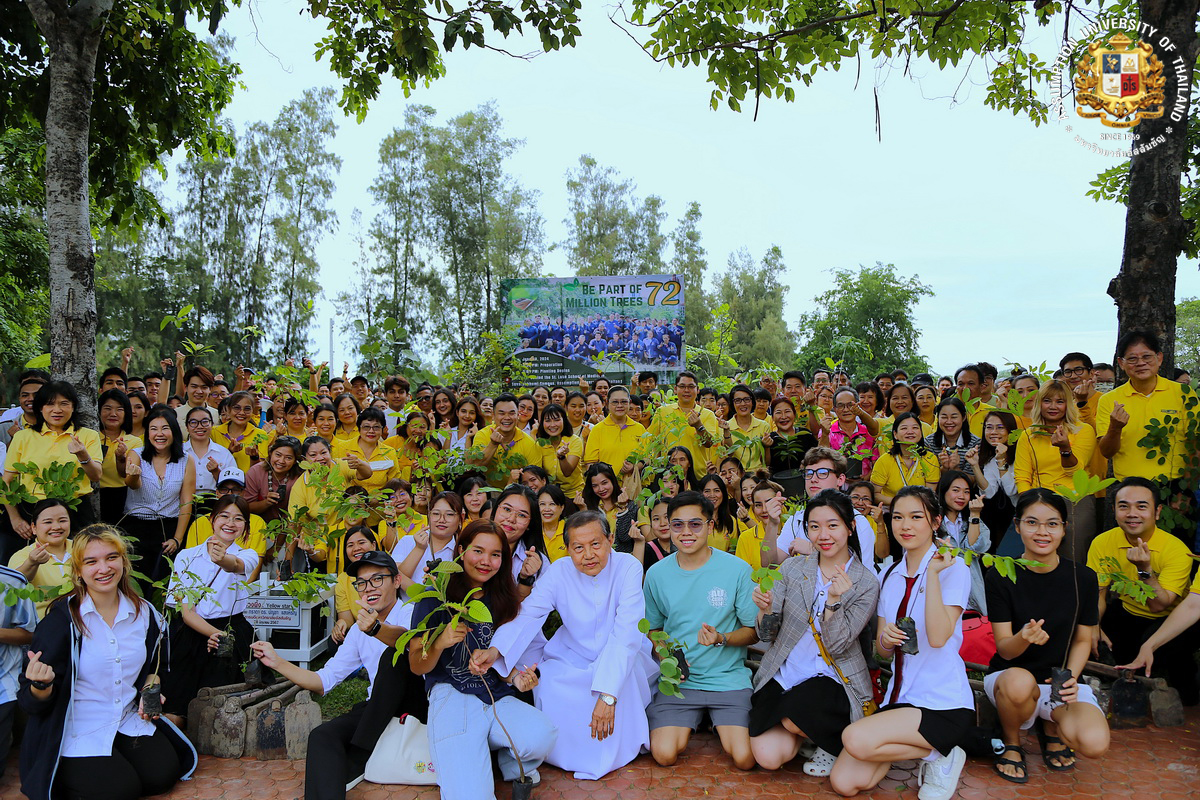
Assumption University organized the 72 Million Trees for Forest Restoration Project to celebrate His Majesty the King’s 6th Cycle Birthday Anniversary. Led by President Rev. Bro. Bancha Saenghiran, approximately 100–120 students, faculty members, and staff participated in the tree-planting activity behind the Faculty of Medicine Building, Assumption University. The initiative demonstrated the University’s commitment to environmental sustainability, forest restoration, and community engagement in support of the government’s campaign to plant 72 million trees in honor of the King’s 72nd birthday.
A New Generation of E-Waste: True Invites Everyone to Recycle for a Greener Planet and a Sustainable Future
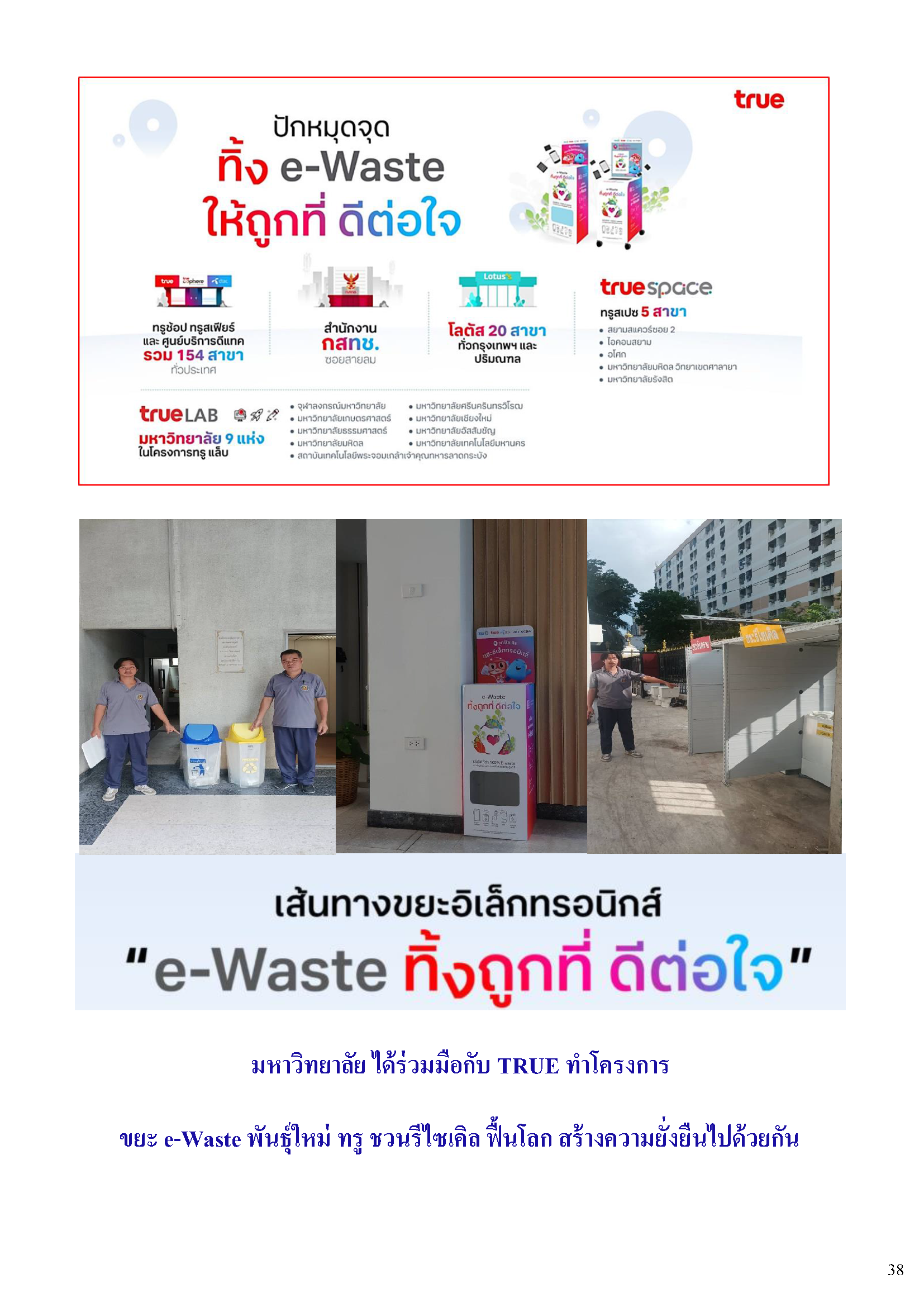
Assumption University promotes environmental sustainability through e-waste recycling initiatives, including the campaign “A New Generation of E-Waste: True Invites Everyone to Recycle for a Greener Planet and a Sustainable Future.” Responsible collection and recycling of electronic waste can help reduce the environmental impacts of improper disposal, recover valuable materials, and conserve natural resources.
By supporting resource recovery and potentially reducing the need for virgin material production, these initiatives can contribute to indirect greenhouse gas emission reductions.
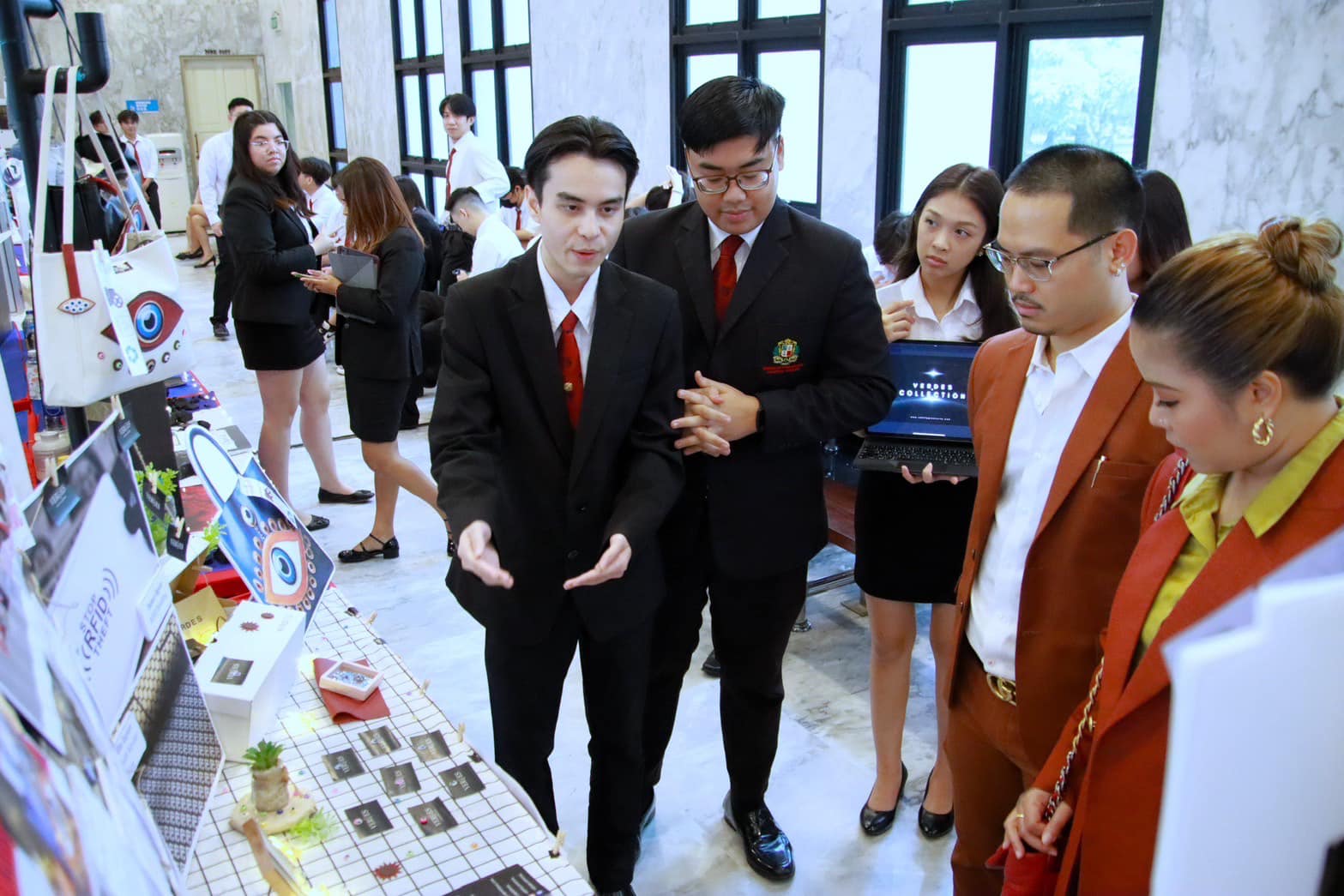
Entrepreneur Showcase 1/2024: Innovating for a Zero-Waste Future
Refrence: https://sustainability.au.edu/entrepreneur-showcase-1-2024-innovating-for-a-zero-waste-future/
As part of the BBA4101 Entrepreneurship course, MSME Business School, Assumption University, successfully organized the Entrepreneur Showcase 1/2024, under the inspiring theme “Zero-Waste”.
A total of 31 student groups presented their creative business ideas and prototypes that emphasized sustainable innovation and responsible consumption. From these, 9 finalist teams were selected to pitch their ideas before a distinguished panel of 4 external judges:
- Dr. Nattee Onin, Chairman of Sappe and CEO of TTT Corporation (AU Alumnus)
- Ms. Taychanun Tangtevanon, Chief Marketing Officer, Whiteline Group
- Mr. Kunthaphatt Nutapotipan, CEO & Co-Founder, Sookjai Digital Agency and Solar Cell (AU Alumnus)
- Dr. Yossaya Chiyaphapharak, CEO & Founder, Satayu Corporation (AU Alumnus)
The competition concluded with the announcement of the Top Three Winning Teams, who received cash awards totaling 10,000 THB, generously sponsored by ABLE Incubator Centre.
This event highlights MSME’s mission to nurture future-ready entrepreneurs who combine creativity, sustainability, and business acumen to make a positive impact on society
7.2.4 Plan to reduce energy consumption
Assumption University of Thailand places great importance on the efficient management of energy and resources to support sustainable development and mitigate the impacts of fluctuations in the global energy situation. Particular attention is given to geopolitical tensions in the Middle East, which affect energy security and economic stability in many countries, including Thailand, which relies significantly on energy imports.
The University has made progress in reducing electricity consumption. In 2024 (B.E. 2567), total electricity consumption was 14,558,000 kWh, compared with 13,710,010 kWh in 2025 (B.E. 2568), representing a reduction of 847,990 kWh, or approximately 5.83%. This decrease reflects progress in the University’s efforts to improve energy efficiency and manage electricity consumption more effectively.
To further strengthen these efforts, the University has established clear measures and operational mechanisms to reduce energy consumption and promote the efficient use of resources across all sectors of the organization. These efforts are guided by the Assumption University Announcement on Short-Term Energy and Resource Conservation Measures in Response to the Global Energy Volatility Crisis, dated March 6, 2026, and Assumption University Order No. 36/2025 on the Appointment of the AU Sustainability Committee. In addition, the University implements an eight-step energy management system to systematically monitor, evaluate, audit, and analyze energy consumption, thereby enhancing energy efficiency and supporting continuous improvement in energy management practices. The following measures demonstrate the University’s practical efforts to conserve energy and resources.
Assumption University Order No. 36/2025 on the Establishment and Appointment of the AU Sustainability Committee
A strong governance framework supports the University’s energy conservation efforts. Through University Order No. 36/2025, Assumption University established the AU Sustainability Committee to oversee sustainability-related initiatives, including energy and resource management. The Committee plays a critical role in policy development, implementation, monitoring, and strategic alignment with the University’s long-term sustainability goals and strategic development plan.
Loading Viewer...
AU Announcement on Short-Term Energy and Resource Conservation Measures: The announcement includes the following measures and guidelines for energy and resource conservation.
- Electricity Conservation Measures
The University has implemented several electricity-saving initiatives to reduce energy consumption in academic and administrative facilities. Air-conditioning systems in offices and classrooms are required to operate at temperatures between 25 and 26 degrees Celsius and must be switched off at least 15 minutes before the end of working or teaching hours, including during lunch breaks. Exceptions are granted only for areas requiring continuous temperature control, such as laboratories and server rooms. Faculty members, staff, and students are encouraged to turn off lights, computers, and electrical equipment when not in use. Furthermore, building and facility management units are responsible for regularly inspecting and maintaining air-conditioning systems and electrical equipment to improve operational efficiency and minimize energy loss.
- Fuel and Transportation Management Measures
To reduce fuel consumption and transportation-related energy use, the University promotes the use of Video Conference systems for inter-campus meetings and communication with external organizations whenever physical attendance is not essential. In addition, personnel and students are encouraged to participate in carpooling programs and utilize the University’s transportation services. Centralized vehicle scheduling is also optimized to reduce unnecessary trips and improve transportation efficiency. These measures contribute to lower fuel consumption, reduced operational costs, and decreased greenhouse gas emissions.
- Resource Management and Operational Measures
Assumption University promotes a Paperless Office policy through the adoption of electronic document systems (e-Document), thereby reducing paper consumption and associated resource use. Water conservation practices are also encouraged throughout the University. Relevant departments are required to prepare contingency plans for essential supplies and operational materials to ensure business continuity during periods of resource uncertainty. Furthermore, departments whose operational nature permits flexible working arrangements may implement Work from Home practices, provided that service quality and operational efficiency remain unaffected.
- Monitoring and Continuous Improvement
To ensure effective implementation of energy conservation measures, the Office of the Vice President for Administration and the Office of the Vice President for Legal and Privilege Affairs are responsible for monitoring compliance and reporting progress to the President on a regular basis. The conservation measures are reviewed monthly or whenever significant changes occur in the energy situation, enabling the University to continuously improve and adapt its energy management practices in response to emerging challenges.
Loading Viewer...
Assumption University of Thailand has implemented an eight-step energy management system to systematically monitor, analyze, evaluate, and improve energy consumption. This process comprises the establishment of an energy management working group, an initial assessment of the current energy-use situation, the formulation of an energy conservation policy, the assessment of energy conservation potential, the establishment of energy conservation targets and action plans alongside training and awareness-raising activities, the implementation of energy conservation plans and review of performance, the monitoring and evaluation of energy management, and the review of results and corrective actions to address identified deficiencies. Through this systematic approach, the University aims to enhance energy efficiency, reduce electricity consumption and operating costs, and promote the sustainable use of energy resources across its campuses.
Step 1: Appointment of Energy Management Working Groups for Schools and Departments
The energy management working groups are appointed by the President of Assumption University of Thailand, with their positions, authority, duties, and responsibilities clearly specified. The appointment order is communicated and publicized through various channels to ensure that all relevant personnel are informed.
Loading Viewer...
Step 2: Preliminary Assessment of Energy Management Status
The University conducts a preliminary assessment of its energy management status using the Energy Management Matrix (EMM) to evaluate the level of readiness and effectiveness of energy management across various aspects. This assessment helps identify strengths and areas for improvement, while providing a basis for establishing appropriate guidelines and measures to enhance the efficiency and systematic implementation of energy management.
Loading Viewer...
Step 3: Energy Conservation PolicyThe University establishes and announces an energy conservation policy in accordance with relevant ministerial regulations. The policy is disseminated through the University’s internal communication channels to raise awareness and encourage personnel to participate in energy conservation initiatives effectively and continuously.
Step 4: Assessment of Energy Conservation PotentialThe University regularly inspects and analyzes energy consumption within its buildings to identify energy losses and opportunities for improving energy efficiency. Appropriate technical improvement measures are thendetermined at three levels: the organizational level, the service level, and the machinery or equipment level. This approach supports efficient energy management and the systematic reduction of unnecessary energy consumption.
Step 5: Establishment of Energy Conservation Targets and Action Plans, Training, and Energy Conservation Promotion ActivitiesAssumption University of Thailand has established a target to reduce energy consumption by 12.50% compared with the 2024 academic year. To achieve this target, the University has implemented four key measures:1. Air Conditioning Replacement: Replacement of 85 air-conditioning units in university offices and classrooms.2. Student Dormitory Air Conditioning Replacement: Replacement of 337 air-conditioning units that have been in use for more than 15 years.3. Lighting Fixture Improvement: Improvement of 120 lighting fixtures in corridors, classrooms, and offices.4. LED Lighting Replacement: Replacement of 2,130 existing lights with energy-efficient 18W and 8W LED Ecofit T8 tube lights in classrooms and faculty offices.
Step 6: Implementation of Energy Conservation Plans and Review of PerformanceThe Energy Management Working Group monitors progress in implementing the established energy conservation measures and action plans. These measures include replacing air-conditioning units, improving lighting fixtures, and replacing conventional fluorescent lamps with energy-efficient alternatives. The implementation process is reviewed to assess progress toward the University’s energy conservation targets and identify areas requiring further improvement.
Step 7: Monitoring and Evaluation of Energy ManagementEnergy management performance is monitored and evaluated by the University’s internal energy management assessment team, appointed under Appointment Order No. 37/2025. The assessment team evaluates the implementation of energy conservation measures and reports the assessment results to relevant stakeholders to support accountability and continuous improvement.
Loading Viewer...
Step 8: Review and Corrective Actions for Energy Management Deficiencies
The Energy Management Working Group consolidates the results of energy conservation activities and reports them to the University’s management. In addition, findings and recommendations from the internal energy management assessment team are used to identify deficiencies, implement corrective actions, and improve energy management practices. This review process supports continuous improvement and enhances the effectiveness of the University’s energy conservation efforts.
7.2.5 Energy wastage identification
Assumption University places importance on effective energy management and the efficient use of energy resources. The University conducts energy assessments of major machinery and equipment in controlled buildings by examining energy consumption, operating hours, and the potential for energy efficiency improvement. This process enables the University to identify equipment that requires priority attention, establish appropriate monitoring and improvement measures, and use assessment results to support energy conservation planning and more effective energy management.
The University has developed an energy assessment form for major machinery and equipment, based on three key criteria: (1) energy consumption, (2) operating hours, and (3) potential for energy efficiency improvement. Each criterion is rated on a scale ranging from the lowest to the highest level, and the scores are used to calculate the overall priority ranking for implementing improvement measures.
According to the assessment results, the equipment evaluated includes chillers, split-type air conditioners, and fluorescent lighting. Split-type air conditioners received the highest overall priority score of 100, ranking first, followed by fluorescent lighting with 48 points, ranking second. Chillers received 2 points, ranking third, As shown in the table below:
Energy Assessment Form for Major Machinery and Equipment
|
Equipment |
Type | (1) Energy Consumption | (2) Operating Hours | (3) Improvement Potential | Total Score (1)*(2)*(3) | Priority Ranking | ||||||||||||
| Lowest | Low | Moderate | High | Highest | Lowest | Low | Moderate | High | Highest | Lowest | Low | Moderate | High | Highest |
|
|||
| Chiller | Electricity |
1 |
1 | 2 | 2 | 3 | ||||||||||||
| Split-Type Air Conditioner | Electricity |
|
5 | 5 | 4 | 100 |
1 |
|||||||||||
| Fluorescent Lighting | Electricity |
|
4 | 4 | 3 | 48 | 2 | |||||||||||
The assessment results provide a basis for identifying equipment that requires further inspection and prioritizing potential improvements, particularly for equipment with higher priority scores. This process supports the University’s efforts to enhance energy efficiency and reduce energy wastage.
The results of this assessment are linked to the energy conservation measures specified under Indicator 7.2.2, which are presented in Table 1 of that indicator. The equipment ranked highest in the assessment, namely split-type air conditioners (ranked first) and fluorescent lighting (ranked second), led to the replacement of 85 air-conditioning units in the University’s offices and classrooms and 337 units in student dormitories that had been in use for more than 15 years. Implementing these two measures reduced overall electricity consumption from 2,885,700.40 kWh/year to 1,293,507.00 kWh/year, a reduction of 1,592,193.40 kWh/year (55.18%).
For lighting, 120 lighting fixtures were improved, and 2,130 existing lights were replaced with 8W, 13W and 18W LED tube lights. These measures reduced overall electricity consumption from 188,042.40 kWh/year to 56,229.60 kWh/year, a reduction of 131,812.80 kWh/year (70.10%).
7.2.6 Divestment policy
Assumption University does not currently have a specific policy on divesting from high-carbon energy industries (such as coal, oil, and natural gas). However, the university has established a Sustainable Procurement Policy, issued by the Procurement Division, Office of Inventory Management, effective April 1, 2025 (B.E. 2568), to ensure that the university’s spending is aligned with the principles of sustainability. The key points are as follows:
Principles: The university is committed to sustainable procurement in accordance with requirements, laws, regulations, and good governance principles, taking into account environmental impact and social and community responsibility, and promoting fair competition.
Objectives: To establish guidelines for sustainable sourcing and supplier management, and to encourage suppliers to follow these guidelines together with a code of business conduct.
Guidelines: The policy covers value for money, transparency, fairness, accountability, business ethics, equal treatment of suppliers, and, in Guideline 4, procurement that takes into account environmental impact and social responsibility.
This policy demonstrates the university’s intent to incorporate environmental and social factors into its financial and procurement decision-making. Although it does not yet cover direct investments, the university plans to review and consider developing a Responsible Investment / Divestment Policy in the future.
Loading Viewer...
7.3 Energy use density
7.3.1 Energy usage per sqm
This indicator is calculated as total energy used divided by the University floor space.
|
Item |
Value |
Unit |
|
Total energy used |
15,730,137 |
kWh/hr |
|
University floor space |
390,339 |
sqm |
|
Energy usage per sqm |
40.299 |
kWh/sqm |
7.4 Energy and the community
7.4.1 Local community outreach for energy efficiency
Assumption University of Thailand (AU) promotes energy efficiency and clean energy awareness through initiatives, educational activities, and collaborations related to sustainable energy. The University seeks to extend knowledge and good practices in energy conservation, renewable energy, and energy-efficient technologies beyond its campuses to benefit the wider community. Through these initiatives, AU encourages community participation, supports the adoption of environmentally responsible practices, and contributes to reducing energy consumption and greenhouse gas emissions in line with Sustainable Development Goal 7: Affordable and Clean Energy. The following projects and activities demonstrate the University’s efforts to promote energy efficiency, raise public awareness of clean energy, and encourage collaboration with local communities and relevant stakeholders.
AU Earth Hero Inspires Young Conservationists Through Hands-On Learning
Reference: https://www.au.edu/au-earth-hero-au-inspires-young-conservationists/
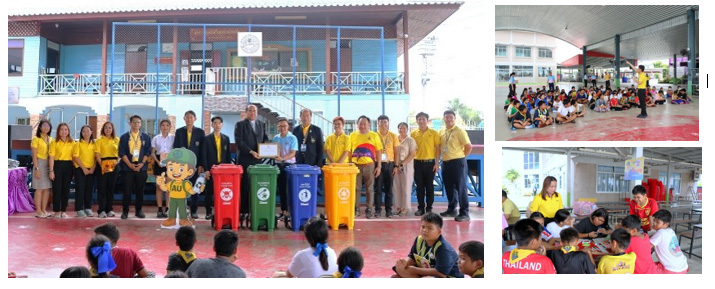
Assumption University of Thailand (AU), through the Institute for Research and Academic Services (IRAS), Albert Laurence School of Communication Arts, and Student Affairs, collaborated with Pag Klong Chuad Yai School to organize “AU Earth Hero,” an engaging program promoting energy conservation and environmental responsibility among young students. The activity took place on August 8, 2025.
The activity introduced students to the principles of the 3Rs—Reduce, Reuse, Recycle—and encouraged simple energy-saving and waste-reduction practices through interactive learning. A highlight was the “3R Adventure Station – Trash-Cutting Quest,” where students worked in teams to apply environmental knowledge through games, problem-solving, and hands-on activities.
To encourage continued action beyond the event, AU provided the school with energy conservation campaign materials and related equipment. The initiative reflects AU’s commitment to environmental education, community engagement, and empowering young people to become responsible stewards of the environment.
7.4.2 100% renewable energy pledge
Assumption University of Thailand has established institutional commitments on clean energy and climate action through the following formally announced policies:
AU Sustainability Committee (Order No. 36/2568, April 1, 2025)
To ensure effective and efficient sustainability management in line with the university’s 5-year strategic plan (2023-2027, revised), the President appointed a 22-member AU Sustainability Committee, comprising an advisor, a chairperson, committee members, and secretaries. The committee is responsible for driving and overseeing sustainability implementation.
Loading Viewer...
Sustainable Environmental Management Policy (Announcement No. 6/2568, April 1, 2025)Issued by the University President under the university’s Policy to Drive the Sustainable Development Goals (April 1, 2025), the policy sets out guidelines for staff and students. Two of its provisions directly relate to energy and climate:
- Sustainable energy management: The university manages energy sustainably through energy-saving measures and promotes the use of clean energy and renewable energy.
- Carbon neutrality and net-zero targets: The university commits to reducing greenhouse gas emissions to achieve Carbon Neutrality by 2050 and Net-Zero greenhouse gas emissions by 2065.
Loading Viewer...
7.4.3 Energy efficiency services for industry
Assumption University recognizes the importance of improving energy efficiency within the industrial sector as a key strategy for reducing operating costs, conserving resources, and lowering greenhouse gas emissions. In support of Sustainable Development Goal 7 (Affordable and Clean Energy), the University actively promotes collaboration with industry partners, government agencies, and other stakeholders to advance knowledge, technology, innovation, and human resource development in energy management and clean energy solutions.
These initiatives encompass academic services, professional training, research activities, technology transfer, and industry partnerships aimed at enhancing energy efficiency and supporting the adoption of sustainable energy technologies. Through such collaborations, the University contributes to the development of a more energy-efficient and sustainable industrial sector.
MOU Driving Innovation: Assumption University and MG Thailand
Forge Sustainable Partnership
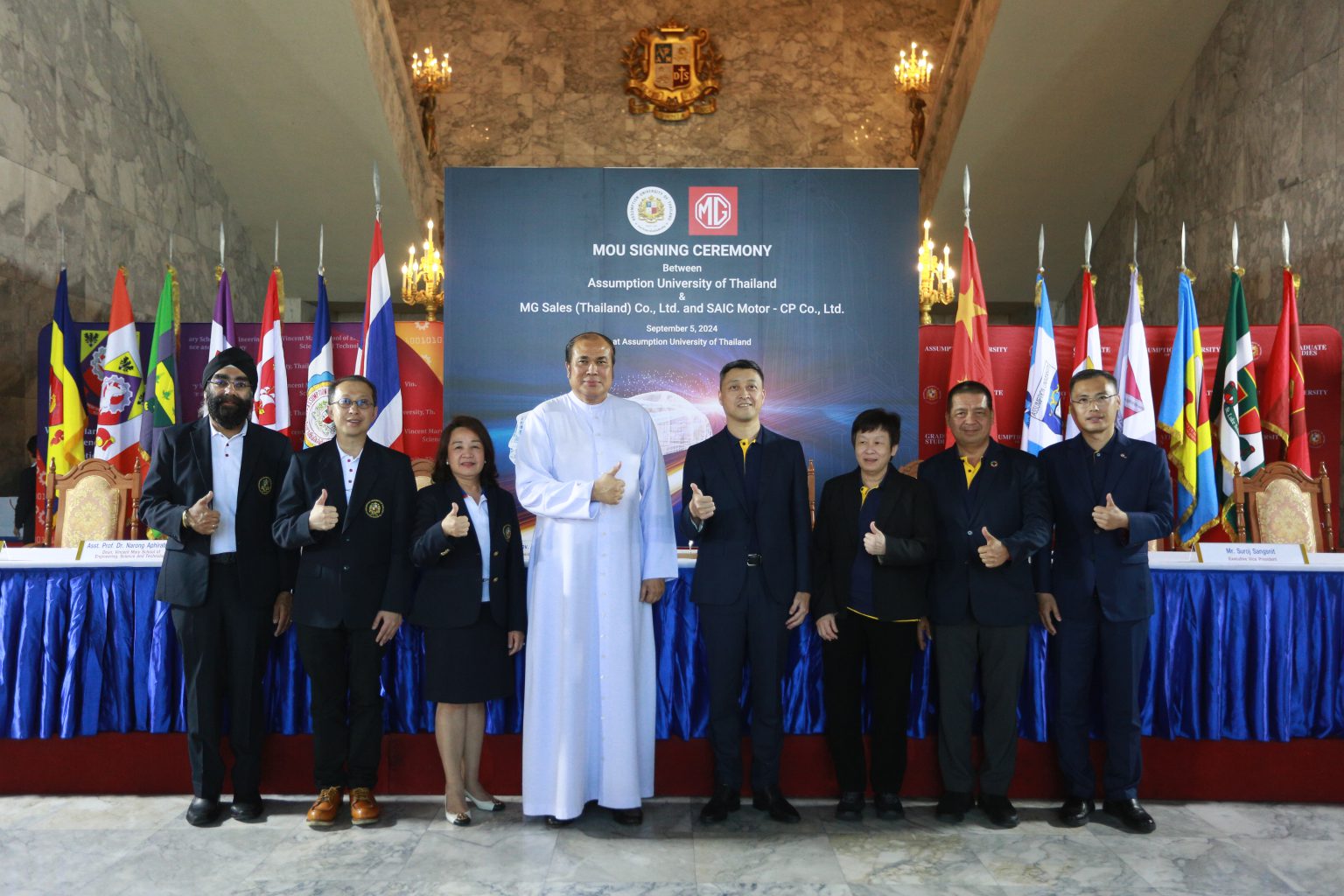
Assumption University of Thailand and MG Sales (Thailand) made a significant move to shape the future of the automotive industry with the signing of a Memorandum of Understanding (MoU) on September 5, 2024. This strategic partnership aims to establish the Alternative Energy Innovation Engineering Center, an initiative that will drive innovation in new energy vehicle technologies.
The ceremony, held at the Lobby of the Cathedral of Learning at Assumption University’s Suvarnabhumi Campus, was graced by key figures from both institutions. Leading the event was Rev. Bro. Dr. Sirichai Fonseka, f.s.g., Ph.D., President of Assumption University of Thailand, alongside Mr. Xu Yin, Authorized Director of MG Sales (Thailand). They were joined by other distinguished representatives, including Asst. Prof. Dr. Uree Cheasakul, Vice President for Academic Affairs of Assumption University, and Miss Nanthanut Laoprasert, Authorized Director of MG Sales (Thailand).
Also in attendance were Asst. Prof. Dr. Narong Aphiratsakun, Dean of the Vincent Mary School of Engineering, Science, and Technology at Assumption University, and Mr. Suroj Sangsit, Executive Vice President of MG Sales (Thailand). Key members of the academic team, such as Dr. Anand Dersingh, Assistant Dean for Engineering and Science Technology Programs at Assumption University, were present as well, alongside Mr. Jia Weichao, Customer Service Director at MG Sales (Thailand).In his welcome address, Rev. Bro. Dr. Sirichai Fonseka emphasized the importance of collaboration between academia and industry, highlighting how the partnership will provide students with hands-on experience and prepare them for the evolving automotive landscape.
AU Advanced EV Education with Chinauto MoU
Reference: https://www.au.edu/au-advanced-ev-education-with-chinauto-mou/
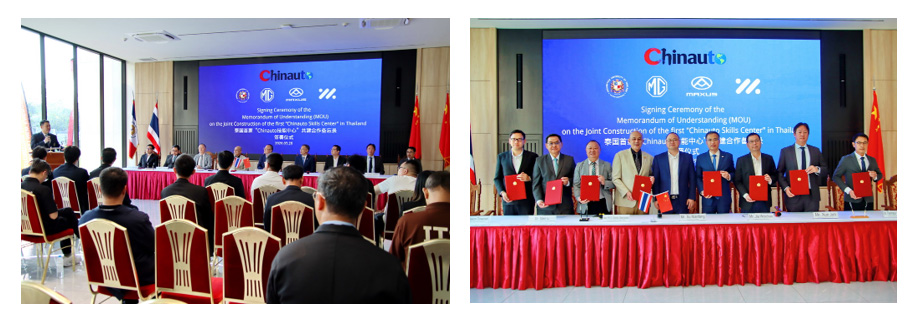
Assumption University of Thailand(AU) hosted academic and industry partners on March 28, 2026, for the Thailand “Chinauto Skills Center” MoU Signing Ceremony, marking a significant step in advancing international collaboration in new energy vehicle (NEV) education and industry-linked training, and formally appointing the Chinauto Skills Center in Thailand.
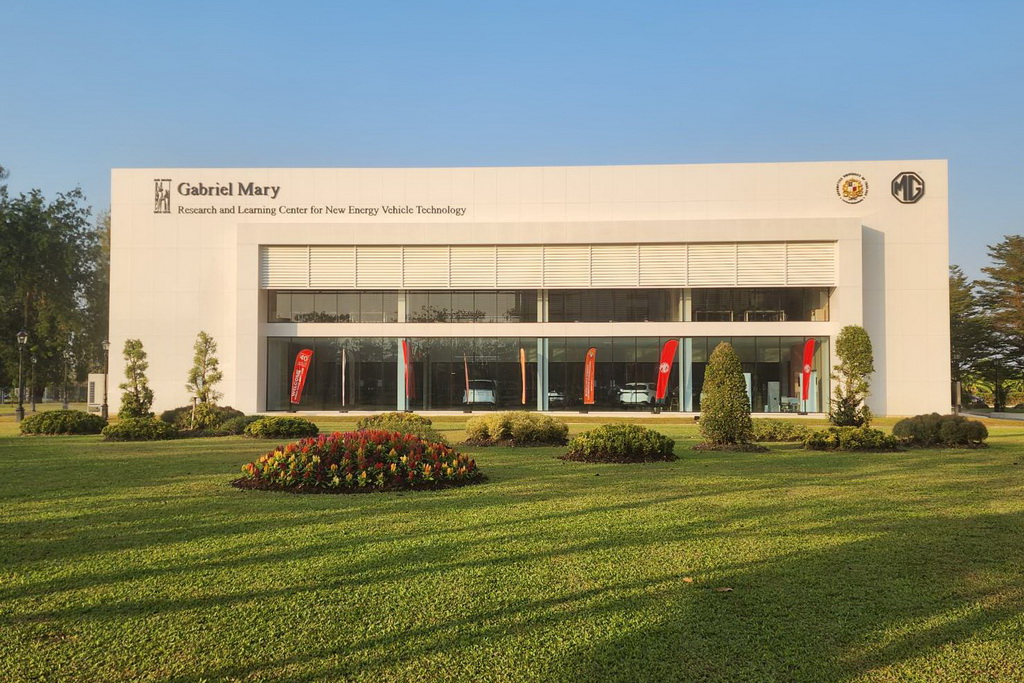
Held at the Gabriel Mary Research and Learning Center for New Energy Vehicle Technology, Suvarnabhumi Campus, the event brought together representatives from SAIC Motor-MG , IM Motors Technology Co., Ltd., and MAXUS Motor (Thailand) Co., Ltd., along with distinguished delegates from China and Thailand. The program featured opening remarks, a presentation of the “Chinauto Skills Center” initiative, and the formal MoU signing.
A key highlight of the ceremony was the official appointment of AU as the Chinauto Skills Center in Thailand, alongside a shared vision to bridge academic learning with real-world industry application. Guests also toured the center, highlighting the university’s strong commitment to innovation in NEV technology.
The event reaffirmed the university’s role as a hub for international collaboration, emphasizing practical education, innovation, and future-ready talent development in the automotive sector.
Powering the Future: AU and Shanghai Strengthen Collaboration in
New Energy Vehicles
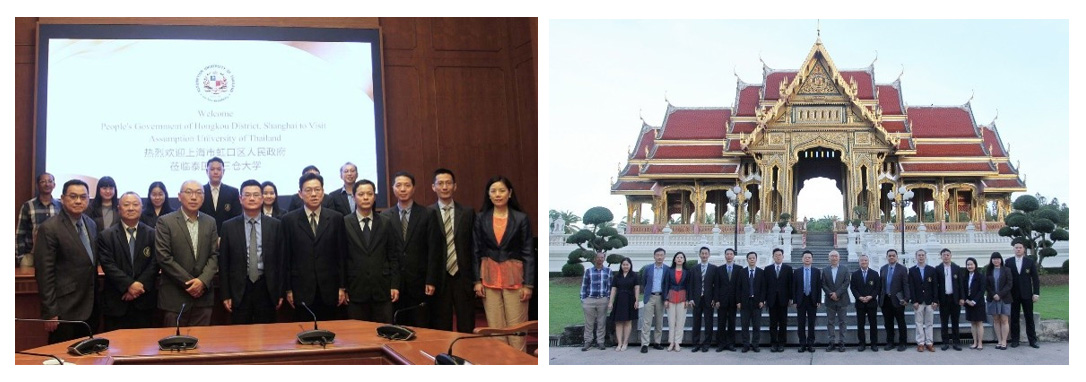
Assumption University of Thailand (AU) welcomed a high-level delegation from Hongkou District, Shanghai, on October 17, 2025, for strategic discussions on education, science, technology, and industry collaboration, with a particular focus on New Energy Vehicles (NEV) and opportunities for expansion across ASEAN.
The delegation visited the Industry–Education Integration Base of the International NEV Science and Education Alliance, a joint initiative between AU and SAIC Motor Thailand (MG). The facility integrates education, practical training, research, and industry engagement to develop skilled talent for the rapidly growing NEV sector.
Asst. Prof. Dr. Kitti Phothikitti, Vice President for Educational Innovation and Graduate Studies, presented AU’s approach to building an ecosystem that connects academia, industry, government, and regional partners to accelerate technological innovation and workforce development.
The delegation, led by Vice District Chief Wu Weiping, emphasized Hongkou District’s commitment to supporting universities and businesses in expanding internationally. Both sides expressed their shared commitment to developing a mutually beneficial platform that promotes sustainable growth, innovation, talent development, and stronger ASEAN–China cooperation in the NEV sector.
7.4.4 Policy development for clean energy technology
Assumption University (AU) recognizes the importance of promoting clean energy and energy-efficient technologies to support the transition toward a sustainable energy system and reduce environmental impacts. The University seeks to promote knowledge creation, research, and information dissemination related to energy conservation and clean energy technologies to support the development of energy policies and implementation approaches at the local, regional, national, and global levels. These efforts can demonstrate the University’s role in applying academic knowledge to support government agencies and policymakers in developing and advancing policies on clean energy and energy-efficient technologies for sustainable development.
1 Local
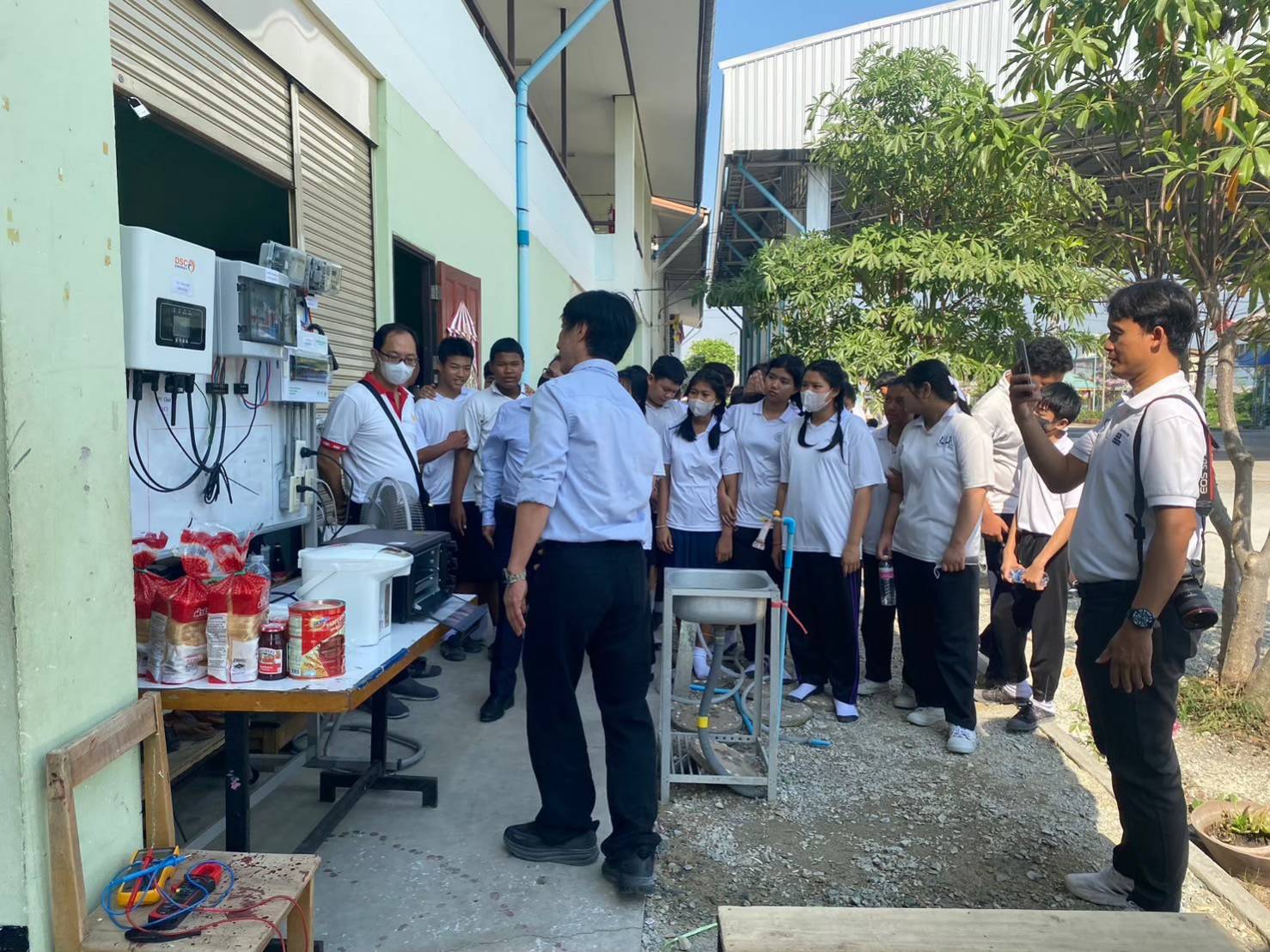
1.1 Training on Solar Cell Technology and Energy Saving for Teachers and Students at Ban Rakat Community School
Lecturers and students from the Vincent Mary School of Engineering, in collaboration with IRAS, visited Ban Bang Rakat School in Bang Bao, Samutprakarn as part of the academic service projects. The purpose of the visit was to engage and educate both students and teachers at the school on the importance of solar-cell technology. The session was designed to provide hands-on experience with an actual solar-cell system, allowing participants to gain practical knowledge about renewable energy solutions.
During the event, the students and teachers had the opportunity to learn about solar energy, its applications, and how it can be used to promote sustainability in their communities. This collaboration not only introduced the concepts of clean energy but also aimed to inspire the next generation to consider the role of renewable energy in their future careers and communities.
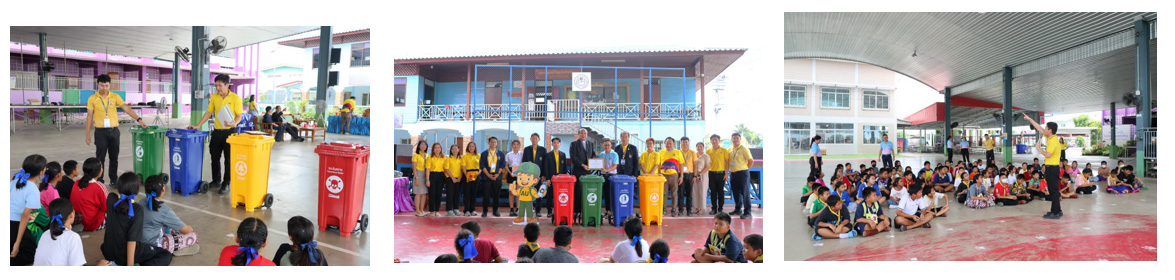
1.2 AU Earth Hero Inspires Young Conservationists Through Hands-On Learning
Reference: https://www.au.edu/au-earth-hero-au-inspires-young-conservationists/
Assumption University of Thailand (AU), through the Institute for Research and Academic Services (IRAS), Albert Laurence School of Communication Arts, and Student Affairs, collaborated with Pag Klong Chuad Yai School to organize “AU Earth Hero,” an engaging program promoting energy conservation and environmental responsibility among young students. The activity took place on August 8, 2025.
The activity introduced students to the principles of the 3Rs—Reduce, Reuse, Recycle—and encouraged simple energy-saving and waste-reduction practices through interactive learning. A highlight was the “3R Adventure Station – Trash-Cutting Quest,” where students worked in teams to apply environmental knowledge through games, problem-solving, and hands-on activities.
To encourage continued action beyond the event, AU provided the school with energy conservation campaign materials and related equipment. The initiative reflects AU’s commitment to environmental education, community engagement, and empowering young people to become responsible stewards of the environment.
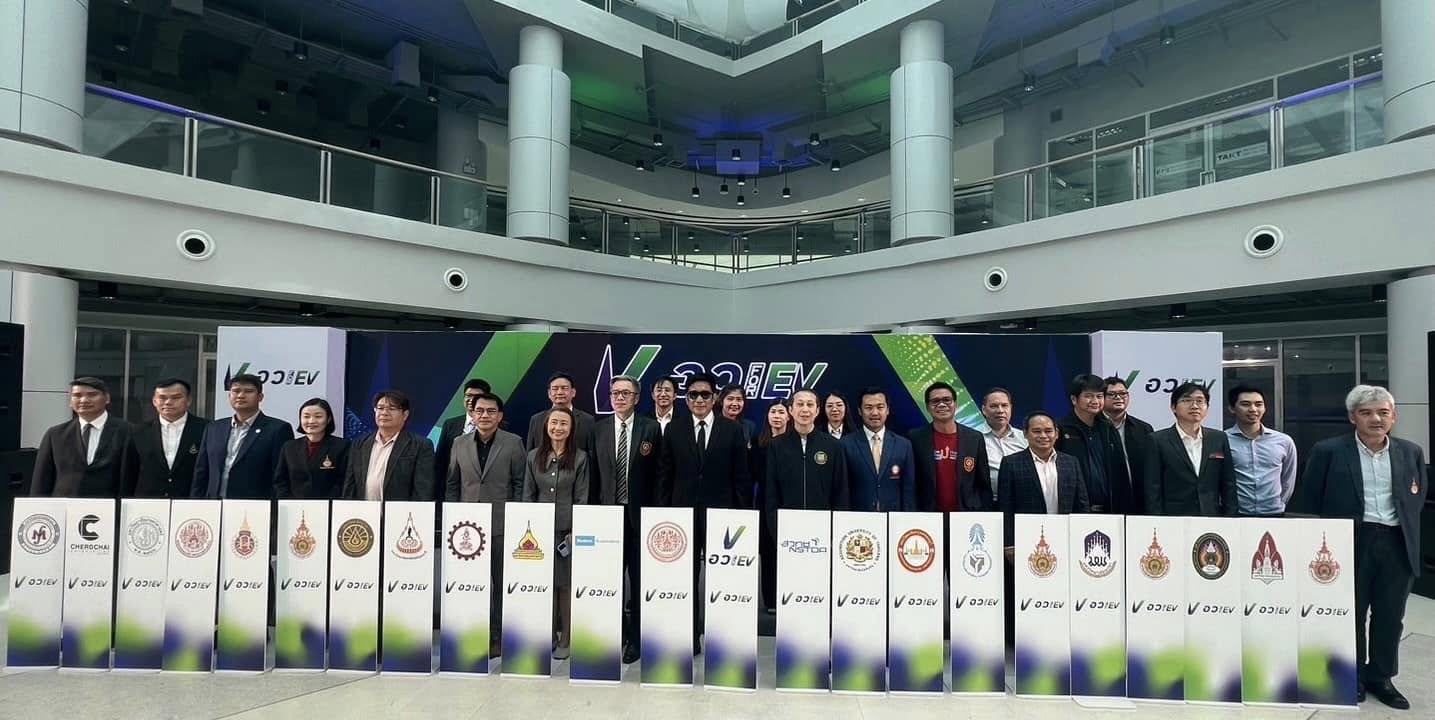
2 National: Assumption University Joins Electric Vehicle Industry Chain Initiative
The Ministry of Higher Education recently convened representatives from universities and the electric vehicle (EV) industry to form a collaborative Electric Vehicle Chain Group. This platform enables members to share knowledge, promote innovative EV activities, and foster synergy across academia and industry.
Vincent Mary School of Engineering, Science and Information Technology (VMES), Assumption University is honored to be part of this initiative. As a member of the chain, VMES will contribute expertise and training to prepare students for emerging careers in the new energy automotive sector.
In line with this, VMES is launching the New Energy Automotive Engineering program in 2025, designed to equip students with cutting-edge skills in EV technology, smart mobility, and sustainable automotive solutions. This program aims to serve both industry needs and students aspiring to careers in the new era of transportation engineering.
3 Regional:
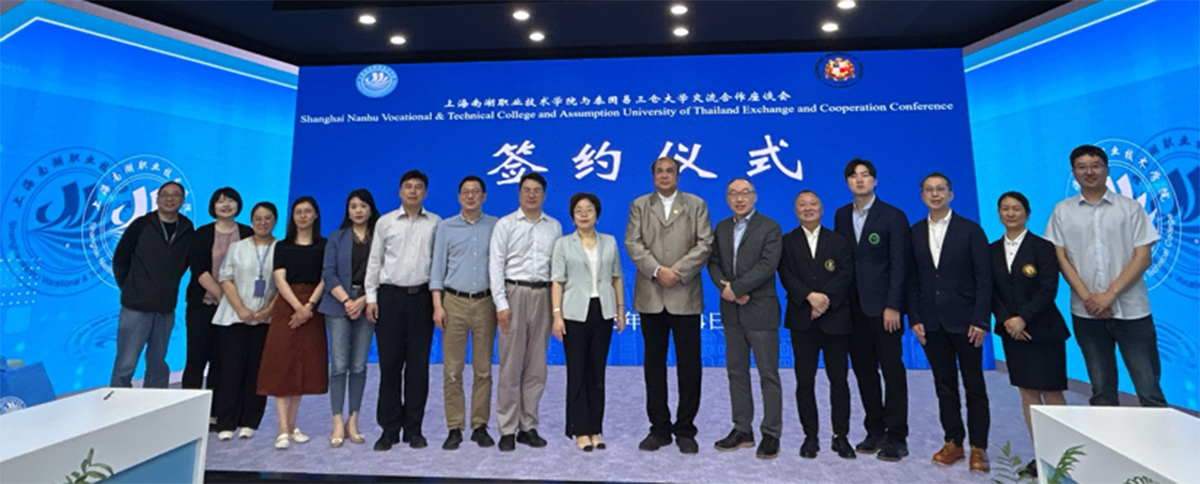
3.1 Shanghai Partnership Signals Smart Future for AU Students
May 14, 2025 — Assumption University of Thailand (AU) has advanced its global collaboration by signing a landmark Memorandum of Understanding (MoU) with Shanghai Nanhu Vocational and Technical College during a strategic visit to China.
The agreement, signed at Nanhu College’s Cultural Center, establishes collaboration in three key areas: intelligent connected vehicles, healthcare training, and metaverse-based education. The AU delegation, led by Rev. Bro. Sirichai Fonseka, f.s.g., Ph.D., President of AU, was warmly received by Prof. Jianliu Zhu, Deputy Party Secretary and President of Nanhu College, together with Vice President Zhou Yifeng.
Nanhu College is organized into five major academic groups—finance and commerce, tourism services, information technology, transportation, and culture and art—and hosts several nationally recognized training facilities such as the Shanghai Vocational Education International Business Open Training Center, the Auto Repair Open Training Center, and the International Cruise Teaching Base.
As part of the visit, the AU delegation toured cutting-edge facilities including the 5G Digital Creativity Training Center, the International Cruise Training Base, and the New Energy Vehicle Smart Connectivity Center—all integrated within Nanhu’s Metaverse Digital Interactive Space. These facilities highlight Nanhu’s innovative approach in merging immersive technologies with vocational education.
The partnership also includes the establishment of a Sino-Thai Intelligent Connected Vehicle Joint Laboratory, focusing on curriculum development tailored to the ASEAN market. In addition, both institutions will collaborate on metaverse-based immersive nursing training, integrating healthcare education with advanced digital technology.
Over the next three years, Nanhu College will welcome 50 Thai exchange students and dispatch faculty to Thailand for co-developing localized academic content—reinforcing the institutions’ shared vision of fostering international collaboration and preparing students for the future of work.
3.2 AU, EVAT and China Auto Charge Up Thailand’s EV Future
Reference: https://www.au.edu/au-evat-and-china-auto-charge-up-thailands-ev-future/
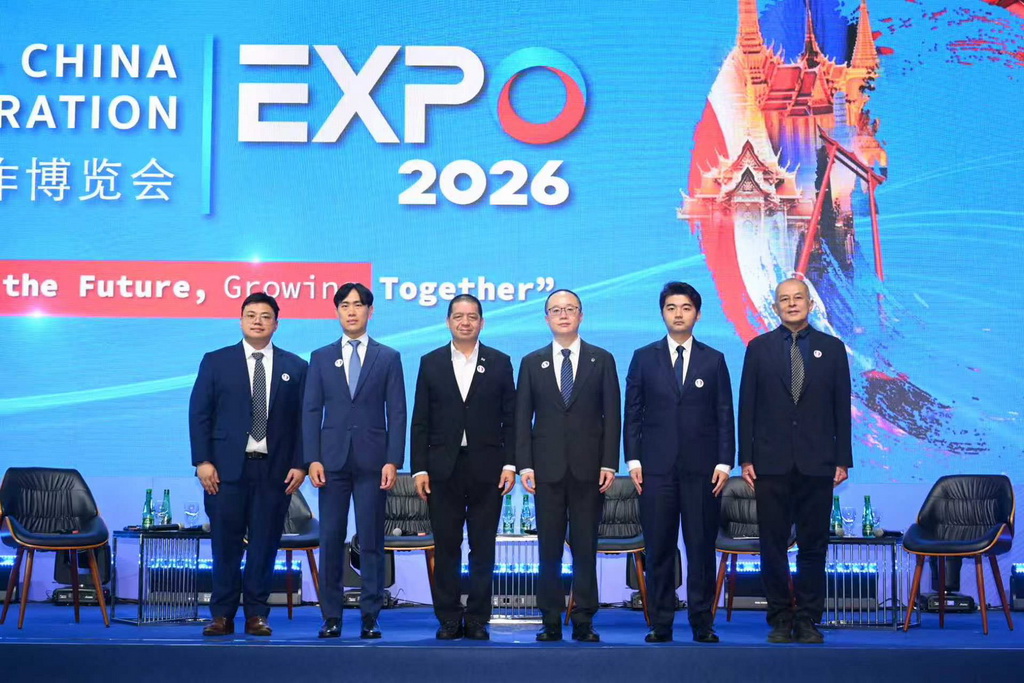
Assumption University of Thailand (AU) has established a tripartite collaboration with the Electric Vehicle Association of Thailand (EVAT) and China Auto, a network of Chinese automotive and new-energy vehicle organizations including CATARC and China EV100. The initiative is a strategic framework connecting education, industry and the Thai–Chinese automotive sector to advance electric vehicle (EV) and future mobility technologies.The collaboration focuses on:Exchange of knowledge, technology, research and industry standards among the three partners, including expertise on policy, technical standards and technological development from China’s automotive sector;Joint research and technology advancement in EV and new-energy mobility;Curriculum and training development, including professional training, internships and career pathways;Linking academia with Thailand’s wider EV ecosystem, through EVAT, which connects stakeholders in policy, technical standards, technology, industrial development and workforce advancement.The initiative supports Thailand’s ambition to become a major ASEAN hub for electric vehicles and future mobility. AU’s Vincent Mary School of Engineering, Science and Technology supports this through the B.Eng. in New Energy Automotive Engineering, the M.Eng. and Ph.D. in Innovation Engineering.
4 Global:
4.1 AU Showcases Industry Collaboration in New Energy Development Journey Book
Assumption University of Thailand (AU) has officially released its strategic publication, “The New Energy Development Journey,” documenting its transformative international academic-industry partnerships. The publication serves as a global reference model designed to inform and support government entities and policymakers in developing policies for clean energy technology, energy efficiency, and sustainable mobility.
The publication highlights AU’s core contributions at the Global / International Level across three key dimensions:
-
Establishing a Cross-Border Global Alliance:
The university co-established the International Alliance for New Energy Vehicle Education and Industry Integration. This cross-border alliance connects higher education institutions, global enterprises, and innovation leaders worldwide to harmonize international technical standards and co-create educational policy frameworks for new energy technologies.
-
International Skill Standardization & Technology Transfer:
Through strategic cooperation with global industry leaders such as SAIC Motor Corporation and MG Thailand, AU has successfully integrated international technical benchmarks into living laboratories on campus. This initiative provides policymakers with practical, data-driven frameworks to establish national skill standards aligned with global clean energy standards.
-
Strategic Policy Reference for Global Decarbonization:
Designed as a forward-looking resource for educators, policymakers, and international organizations, the publication outlines scalable models of education–industry integration. It serves as an actionable guidebook for governments seeking to implement effective capacity-building and workforce development policies for the global transition toward electric mobility and clean energy.
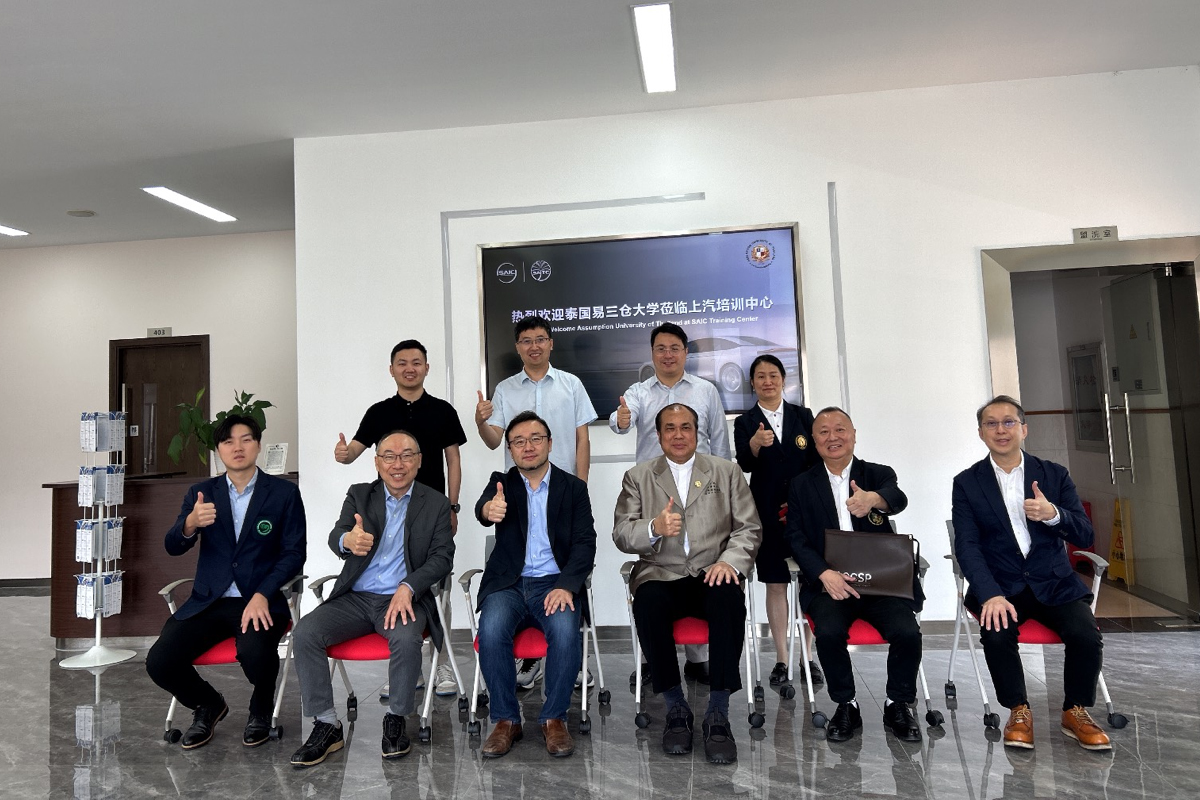
4.2 Driving Innovation: AU and SAIC Motor Gear Up for Green Automotive Future
May 14, 2025 — Assumption University of Thailand (AU) has advanced its global collaboration by signing a landmark Memorandum of Understanding (MoU) with Shanghai Nanhu Vocational and Technical College during a strategic visit to China.
The agreement, signed at Nanhu College’s Cultural Center, establishes collaboration in three key areas: intelligent connected vehicles, healthcare training, and metaverse-based education. The AU delegation, led by Rev. Bro. Sirichai Fonseka, f.s.g., Ph.D., President of AU, was warmly received by Prof. Jianliu Zhu, Deputy Party Secretary and President of Nanhu College, together with Vice President Zhou Yifeng.
Nanhu College is organized into five major academic groups—finance and commerce, tourism services, information technology, transportation, and culture and art—and hosts several nationally recognized training facilities such as the Shanghai Vocational Education International Business Open Training Center, the Auto Repair Open Training Center, and the International Cruise Teaching Base.
As part of the visit, the AU delegation toured cutting-edge facilities including the 5G Digital Creativity Training Center, the International Cruise Training Base, and the New Energy Vehicle Smart Connectivity Center—all integrated within Nanhu’s Metaverse Digital Interactive Space. These facilities highlight Nanhu’s innovative approach in merging immersive technologies with vocational education.
The partnership also includes the establishment of a Sino-Thai Intelligent Connected Vehicle Joint Laboratory, focusing on curriculum development tailored to the ASEAN market. In addition, both institutions will collaborate on metaverse-based immersive nursing training, integrating healthcare education with advanced digital technology.
Over the next three years, Nanhu College will welcome 50 Thai exchange students and dispatch faculty to Thailand for co-developing localized academic content—reinforcing the institutions’ shared vision of fostering international collaboration and preparing students for the future of work.
7.4.5 Assistance to low-carbon innovation
Assumption University (AU) recognizes the importance of promoting low-carbon innovation as a key mechanism for reducing greenhouse gas emissions and advancing sustainable development. The University emphasizes the promotion of academic knowledge, research, and the application of environmentally friendly technologies to support the development of ideas, products, processes, and operational practices that reduce energy consumption and minimize environmental impacts. Furthermore, fostering collaboration among universities, businesses, government agencies, and communities can help advance the development and practical application of low-carbon innovations, generating long-term positive impacts on society and the environment. Collaborations at Assumption University that promote and support a low-carbon economy or low-carbon technologies are as follows:
- The ABLE-UBI Center at Assumption University
Reference: https://www.au.edu/the-able-ubi-center-at-assumption-university/?utm_source=chatgpt.com
The ABLE-UBI Center at Assumption University of Thailand (AU), established on October 27, 2014, serves as a university business incubator with a mission to foster entrepreneurship and innovation sustainably and ethically. Guided by its vision of becoming the “Leading university business incubator in ASEAN,” the center offers services such as business consulting, assistance with planning and registration, startup grants, and training sessions. It aims to inspire students, alumni, and entrepreneurs to launch and grow successful businesses by leveraging academic resources, cutting-edge technologies, and research.
Through its business incubation services and access to funding, the ABLE-UBI Center provides a potential mechanism for supporting low-carbon innovation, particularly when startup projects focus on renewable energy, clean technologies, resource efficiency, or carbon emission reduction. These activities can help innovative ideas progress toward business development and practical application.
- Entrepreneur Showcase 1/2024: Innovating for a Zero-Waste Future
Reference: https://sustainability.au.edu/entrepreneur-showcase-1-2024-innovating-for-a-zero-waste-future/
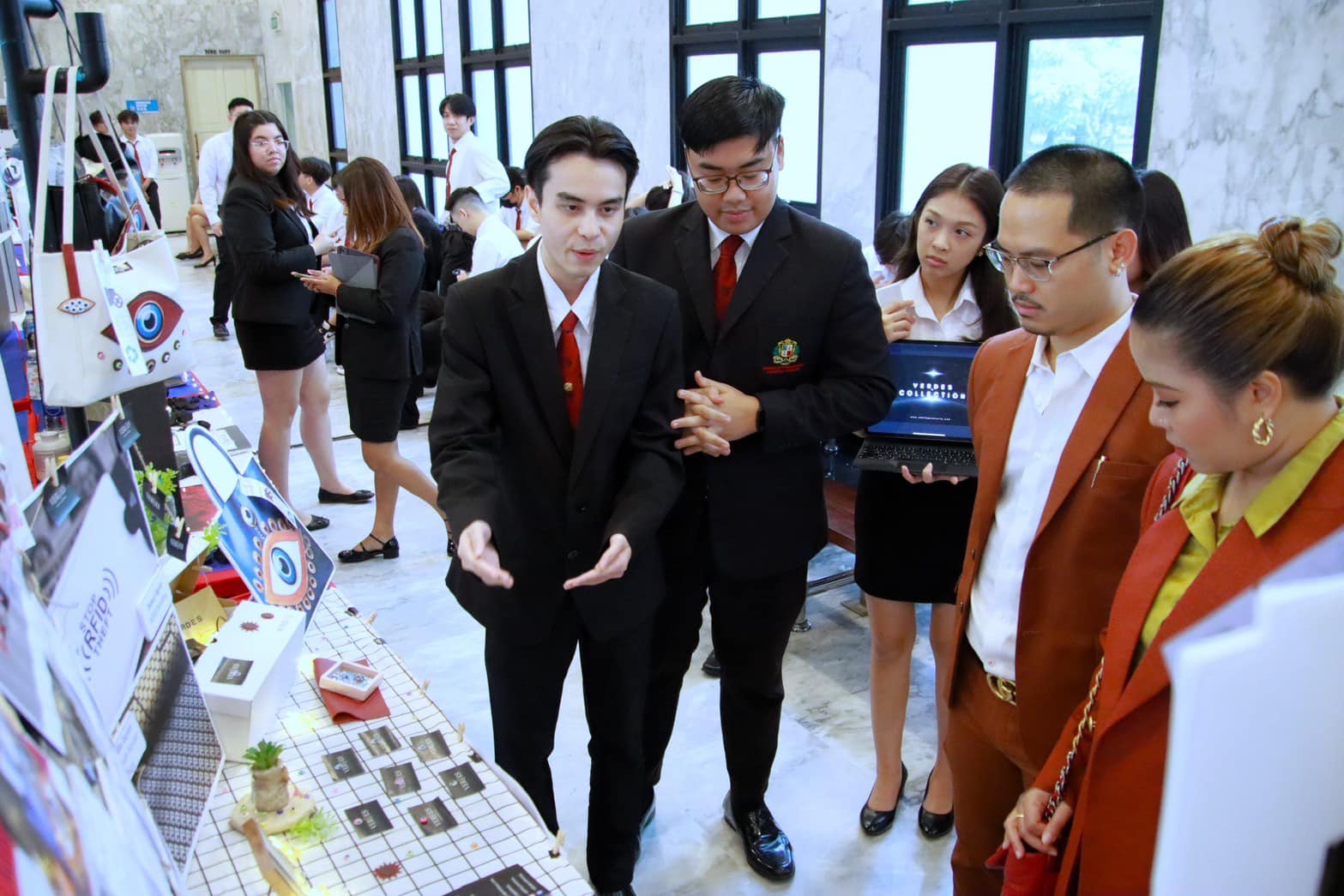
The Martin de Tours School of Management and Economics (MSME) at Assumption University of Thailand (AU) organised an entrepreneurship event under the BBA4101 Entrepreneurship course, focusing on the theme “Zero-Waste.” The event provided a platform for 31 student groups to develop and present business ideas and prototypes that emphasised sustainable innovation, resource efficiency, and responsible consumption.
Nine finalist teams presented their business concepts to a panel of four external judges, including alumni entrepreneurs and business executives. The top three teams received cash awards totalling THB 10,000, sponsored by the ABLE Incubator Centre, to recognise and encourage entrepreneurial innovation.
By encouraging students to explore sustainable business solutions, including ideas related to renewable energy and clean technology, the event supported the development of innovative approaches that could contribute to reducing waste, improving resource efficiency, and lowering carbon emissions. This initiative demonstrates AU’s support for early-stage, low-carbon innovation through entrepreneurship education, prototype development, and engagement with external business experts.
7.5 Low-carbon energy use
7.5.1 Low carbon energy use
|
Item |
Value |
Unit |
| Total energy used |
15,730,137.00 |
kWh/year |
| Total energy used from low-carbon sources |
รอตัวเลขปริมาณไฟฟ้าที่ผลิตได้จากที่ Solar roof ตึก MG |
kWh/year |